Galerist turns 25 with a ‘Labour of Love’
Also this week: Italian garden dining, Anatolian carpets and Europe’s unfinished frontiers

Welcome back to AL-MONITOR Istanbul.
Late September is when Istanbul is at its best, and this year the calendar is so crowded that the only sensible advice is to drop everything, work included, and head “into the polis.” Art lovers from across Turkey are doing just that, converging on Tersane Istanbul for Contemporary Istanbul, where more than 70 Turkish and international galleries from 24 countries bring out their best until Sept. 27.
We start at Galerist, which turns 25 with a show about love and labor, and end in the 1930s with the press photographers who worked behind the scenes of the young republic.
If you want to receive this newsletter or our other weekly City Pulse newsletters — for Doha, Dubai and Riyadh — sign up here.
Thanks for reading,
Nazlan (@NazlanEr on X)
P.S. Have tips on Istanbul’s culture scene? Send them my way at nertan@al-monitor.com.
Also, don’t forget to follow us on Instagram: @citypulsealm

1. Leading the week: A matter of the heart

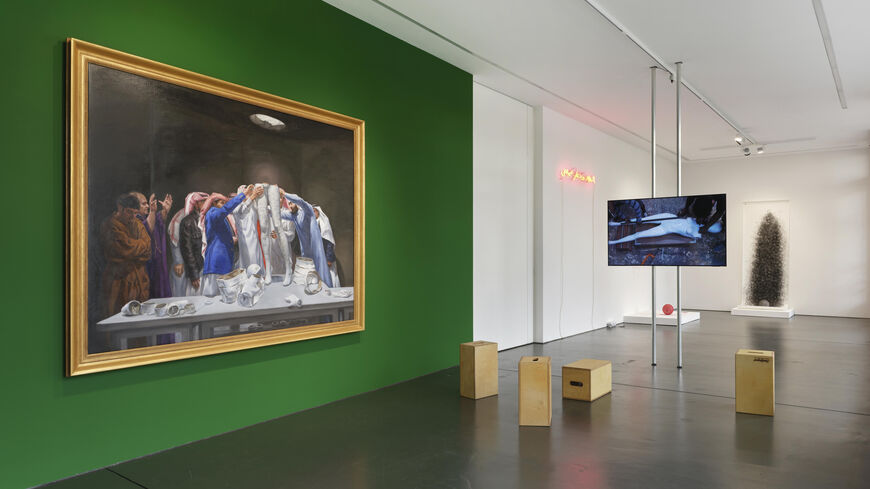
An installation view of “Labour of Love.” (Photo courtesy of Galerist)
Some galleries are white boxes. Galerist, arguably the best-located gallery in Beyoglu, is a sequence of moods. Housed in Passage Petits-Champs, a 19th-century building in Tepebasi, its rooms move from bright halls with the old painted plaster left exposed to small, dark, square chambers where a single work is lit like a relic. For its 25th anniversary, the setting has become a mirror.
“Labour of Love” (in Turkish “Gonul Isi,” roughly “a matter of the heart”) gathers nearly 50 artists who have shaped the gallery since 2001, pairing works from the gallery’s history with pieces made for the occasion. Each work is asked to act as a self-portrait: not necessarily a face, but a gesture, material or obsession that defines a practice. Together they form a portrait of the gallery itself.
The result is fiercely modern and oddly intimate. Semiha Berksoy, the opera diva turned painter, sets the tone with “Death Due to Love” (1998). Nil Yalter revisits “Skin Story” two decades later, Hussein Chalayan contributes a new “Airmail Dress” and Huseyin Bahri Alptekin’s “Hospitality/Hostility (Hotel Istanbul)” reminds us that this city has always offered both. Yusuf Sevincli submits a literal “Autoportrait.”
And because every love story needs its moment of candor, Michael Craig-Martin’s “Untitled (Cash)” hangs in the mix. A quarter century of devotion also requires someone to pay the rent.
The roster, built on a commitment to equal gender representation, reads like a family tree of contemporary art in Turkey, stretching from Ayse Erkmen and Sarkis to Hera Buyuktasciyan and Elif Uras, alongside Thomas Ruff and Erwin Wurm. Go slowly, room by room.
Date: until Nov. 7
Location: Passage Petits-Champs, Mesrutiyet Cad. 67/1, Tepebasi, Beyoglu

2. Word on the street: Worth the bridge

Inside Il Sud Giardino on Bagdat Caddesi. (Photo courtesy of Il Sud)
My mother, the toughest restaurant critic I know, has given her blessing to Il Sud, which is reason enough for European-side loyalists to cross the Bosporus. Founded in Moda in 2021 by Utku Kaymak, an engineer turned ALMA-trained cook, it has opened a second branch, Giardino, in one of the last old villas off Bagdat Caddesi, with tables under the garden trees or in a winter garden. It is a bit costly, so go with a group and share: vitello tonnato, lasagne verde with lamb ragu, red prawn tagliatelle and a Neapolitan pizza with lamb pancetta.

3. Istanbul diary

Seda Gazioglu, “Do Not Feed the Artist.” (Photo courtesy of the artist/Merdiven Art Space)
Merdiven Art Space hosts Seda Gazioglu’s “Do Not Feed the Artist,” which turns the zoo warning into a threat issued in her name. She slashes antique Anatolian carpets, paints over them in oil and stitches them shut with brass wire, leaving every seam visible. Above, the curator’s brain is on the menu. Until Oct. 17.
Lenzart space, a new gallery in Nisantasi, opens with “A Disenchanted World,” curated by Derya Yucel, bringing together 12 artists, among them CANAN and Pinprick, to suspend the idea that the world has been fully explained. Oct. 15 - Nov. 29.
Pi Artworks pairs Nancy Atakan and Dilek Aydin in “Sweet Separation,” which treats birth as a parting that is also a beginning, with embroidered baby blankets, a “Bye Bye Baby” neon sign and open-mic sessions for women to share their birth stories. Until Oct. 31.
Sanatorium asks you to take off your shoes. In Christiane Peschek’s “Phoenix Castle,” visitors cleanse themselves with scented ash beside a pit where incense slowly burns the word “HUMAN.” Until Oct. 31.

4. Book of the Week: ‘Hinterlands’

The Financial Times named Hannah Lucinda Smith’s “Hinterlands: Journeys through Europe’s Unfinished Frontiers” one of its best books of the summer, and I have only now, with summer safely over, got around to it. Smith, the author of “Erdogan Rising,” travels along Europe’s disputed edges, from Kosovo and Abkhazia to Northern Cyprus, where Russian resorts have sprung up along the coast. Her case: these overlooked gray zones, not the capitals, are where the lines of the new Cold War are being drawn.

5. Istanbul gaze

A press photographer at the scene, Istanbul, 1930s. (Photo courtesy of the Suna and Inan Kirac Foundation Photograph Collection, Press Photographs Archive)
A photographer in a bowler hat balances on a fire ladder at a barred window, and the firemen below watch him rather than the story. The frame hangs in “The Republic Behind the Scenes” at Pera Museum, where curators Idil Cetin and Ahmet Ersoy mine early Republican press negatives, many of them by Selahattin Giz and Namik Gorguc, for prisoners, the poor and the street. Sept. 29 - March 28.
6. By the numbers
Istanbul may be at its cultural peak, but a July survey of 758 residents by the Istanbul Planning Agency suggests that many are watching from the sidelines:
● 45.8% had attended no cultural event in the past year. Among those who had, concerts were the most common, at 33.9%, ahead of theater and stand-up (21.8%) and galleries and museums (21.2%).
● 45% named high ticket and entry prices as the main barrier, followed by lack of time (38.1%).
● Residents spend an average of 3 hours and 8 minutes a day on digital entertainment, compared with 3 hours and 44 minutes of free time.
This one's on us.
The story doesn't end here.
Our correspondents are already on the next chapter. Read everything they file, from $2/week.
See Offers