Huawei faces US court test over Iran ties

Hi readers,
As the US and Iran conflict drags on, an old federal case is putting a spotlight on one of the less visible dimensions of the China-Iran relationship: technology.
The issue concerns whether Huawei used a business partner in Iran to evade US sanctions, mislead banks and officials and obtain US-origin goods and services. The case offers a window into how aggressively Washington is prepared to pursue Chinese companies that support Iran and how far it can pressure Tehran without provoking a broader confrontation with Beijing.
Let's dive in,

Leading this week
Case against Huawei
According to the indictment, Huawei used Skycom, a Hong Kong-based company that prosecutors describe as its unofficial Iranian subsidiary, to conduct business in Iran.
Prosecutors allege that Skycom helped Huawei obtain US-origin technology, goods and banking services while concealing its ties to Huawei and that between 2010 and 2014, more than $100 million in Skycom-related transactions passed through the US financial system.
Huawei reportedly presented Skycom as an independent local partner and told US officials and financial institutions that its Iran-related activities complied with US law.
Prosecutors also allege that Skycom, acting on Huawei’s behalf, installed equipment used by Iranian authorities to monitor, identify and track protesters during the 2009 demonstrations.
In 2021, Huawei Chief Financial Officer Meng Wanzhou made a deferred prosecution agreement with the US Justice Department and admitted to making material misrepresentations to a global financial institution about Huawei’s Iran business. The agreement ended US extradition proceedings against her in Canada.
Should the jury find Huawei guilty on some or all of the charges, the company could face criminal penalties, including the forfeiture of proceeds that prosecutors argue were obtained through illegal activity.
Broader consequences for Huawei could come via separate action by US agencies, particularly the Commerce Department, which controls export restrictions, and the Treasury Department, which administers US sanctions. Huawei is already subject to extensive restrictions through the Commerce Department’s Entity List, but a conviction could potentially lead to additional restrictions.

People visit the Huawei stand during the Mobile World Congress at the Shanghai New International Expo Center in Shanghai on June 18, 2025. — HECTOR RETAMAL/AFP via Getty Images
Huawei’s footprint in Iran
Huawei has operated in Iran’s telecommunications industry since 1999, according to China’s embassy in Tehran. Its commercial ties included MTN Irancell, Iran’s second-largest mobile operator, which bought Huawei telecommunications equipment in 2011, according to a 2012 Reuters investigation. Huawei denied providing technology for monitoring or filtering communications, saying its work in Iran was limited to commercial and civilian equipment.
Reuters also reported that Huawei sought a roughly $1.5 million partnership with MobinNet ahead of its 2010 launch of Iran’s first nationwide wireless broadband network. The proposed partnership would have enabled security agencies to monitor subscriber traffic in real time, though Reuters could not confirm whether the deal was completed.
A February 2026 report by Article 19 identified Huawei, ZTE, Tiandy and Hikvision as Chinese companies that have supplied technology used in Iran’s internet filtering and surveillance infrastructure. All four companies reportedly continue to operate in Iran.
Precedents from ZTE, Halkbank
Washington has pursued similar cases before. In 2017, Chinese telecoms company ZTE pleaded guilty to violating US sanctions, obstructing justice and making false statements after shipping about $32 million in US-origin goods to Iran without the required licenses. Unlike Huawei, ZTE avoided trial by accepting responsibility through a plea deal, agreeing to pay $1.19 billion in penalties. The Commerce Department later found that the company had violated its settlement agreement and temporarily cut it off from US-controlled goods and technology.
The Huawei case also echoes the prosecution of Turkey’s state-owned Halkbank, which US prosecutors accused of helping Iran access roughly $20 billion in restricted oil and gas proceeds. That case was dropped in June 2026 under an agreement imposing Iran-related transaction restrictions and compliance monitoring but requiring no admission of wrongdoing or criminal penalty.
Expert view: John Calabrese, a senior fellow at the Middle East Institute, said the Huawei case “demonstrates that Washington is prepared to pursue major Chinese companies when it believes they have violated US sanctions or deceived the US financial system.” Calabrese told Al-Monitor, however, that the US’ broader policy is “constrained by the reality that China is too important to Iran’s economy, and to the US-China relationship, to be treated simply as just another sanctions target set.”
Washington has targeted Chinese oil buyers and refineries as well as vessels and shipping companies it says transport Iranian oil. But it has stopped short of targeting major Chinese financial institutions.
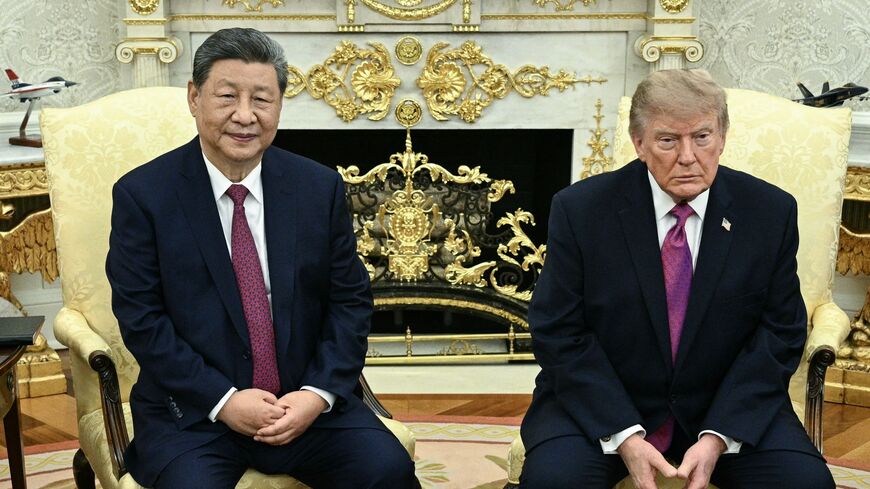
That restraint creates a dilemma for the US. Washington can punish individual Chinese companies without necessarily destabilizing the broader relationship with Beijing. Targeting a large Chinese bank, for example, could turn Iran sanctions enforcement into a much broader US-China rupture — or complicate the planned meeting between President Donald Trump and China's Xi Jinping in Washington later this month.
“The more effective Washington wants its Iran sanctions to be, the more pressure it ultimately has to put on China,” Calabrese said. “But the more pressure it puts on China, the harder it becomes to manage the broader US-China relationship.”

Photo of the week

Supporters of Huawei Technologies CFO Meng Wanzhou stand outside the courthouse as she arrives on the first day of trial on Jan. 20, 2020, in Vancouver, Canada. (Jeff Vinnick/Getty Images)

Deals and visits ✈️
- UAE's Mubadala invests in Chinese coffee chain Luckin Coffee
- Qatari foreign minister visits Beijing
- Syria, China mark 70 years of diplomatic ties at the Syrian Embassy in Beijing
- Saudi deputy foreign minister meets with Chinese ambassador
- Libyan bank to launch direct payment service to China using Alipay
- China's Xi Jinping, Iran's Masoud Pezeshkian to attend BRICS summit in New Delhi
- China's Sunstone Development signs MoU to establish anode production facility in UAE
- Interior minister of Libya's Tripoli-based government travels to China
- Chinese international trade council, UAE Ministry of Investment sign MoU
- Dubai Holding awards construction contract in UAE to China State Construction Engineering Corporation

What we are reading
- How a billion-dollar sanctions dodge kept Chinese goods flowing to Iran: Reuters
- Saudi AI firm Humain unveils model based on China's MiniMax: Bloomberg
- World’s biggest relationship? Xi and Modi look to rebuild ties for 2.8B people: Financial Times
This one's on us.
The story doesn't end here.
Our correspondents are already on the next chapter. Read everything they file, from $2/week.
See Offers