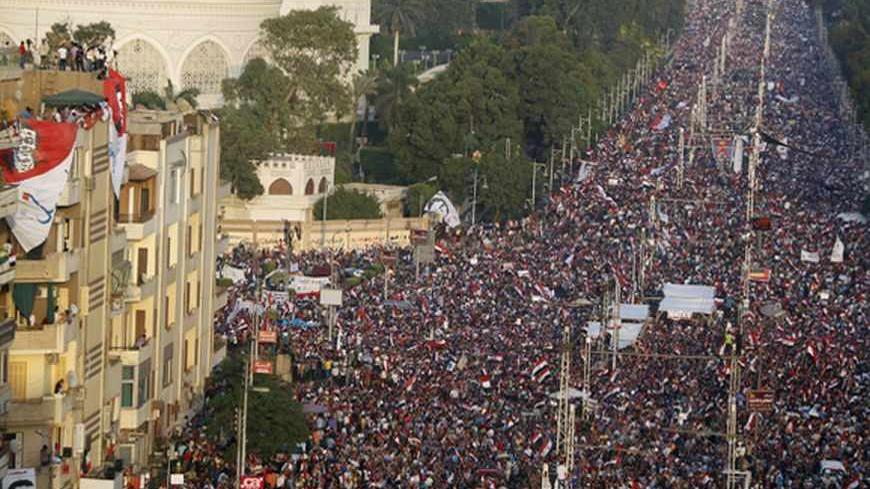
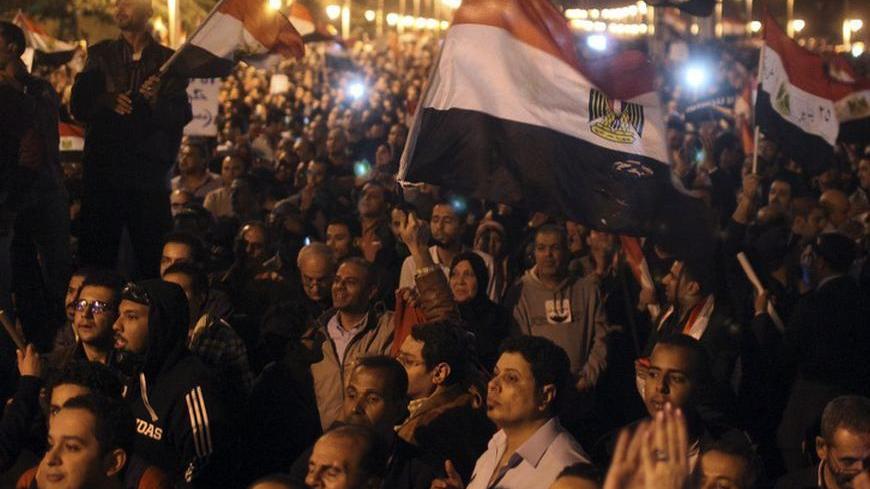
A new microbus route runs between a public transport hub in downtown Cairo and the presidential palace in the suburb of Heliopolis, where for the past week demonstrators have staged the largest demonstrations since Mohammed Morsi assumed the presidency in July.
A middle-aged protester boarding that bus line at the palace late Thursday night asked, “Where are we going tomorrow? Here or Tahrir?”
The response from several young men checking Facebook updates on their phones speaks to a decisive shift in the nature of Egypt’s ongoing street protests. “Here,” they said in unison.
While last week’s relocation of demonstrations from
Tahrir Square to the palace gates generated a bewildering new physical landscape for protesters, the symbolic shift also reflects the opposition movement’s evolution from unanimous condemnation of 30 years of dictatorship to heated contestation of raw political power.
Tens of thousands of demonstrators first marched to the heavily guarded palace last Tuesday and began a sit-in to protest Egyptian leader Mohamed Morsi’s recent power grab and the referendum on a draft constitution set for Dec. 15.
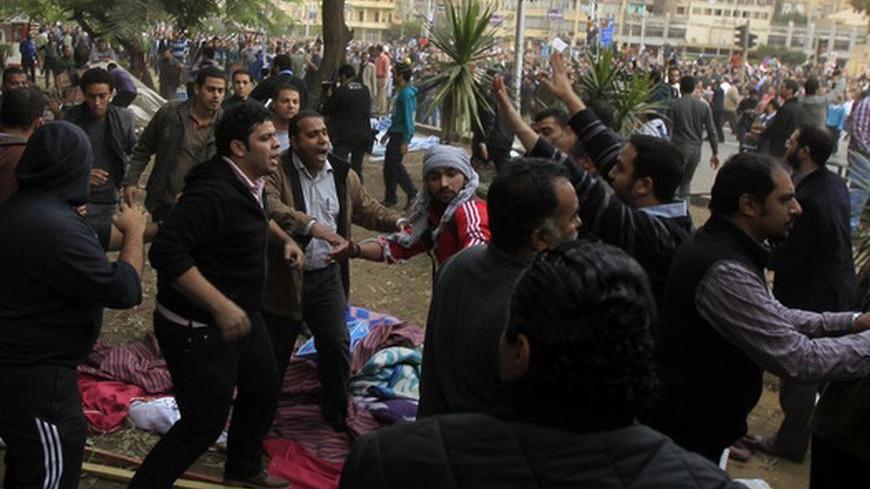
In violent clashes with the president’s supporters on Wednesday night, hundreds were injured and at least six killed, according to the Ministry of Health. Opposition protesters remained in the area as the military built a concrete wall at one entrance to the road leading to the palace, reminiscent of those that have blocked off the Ministry of Interior from Tahrir Square for the past year.
“We went to the palace because when we went to Tahrir, nobody did anything for us,” said Mostafa Saad, a 28-year-old accountant.
When demonstrators occupied Tahrir in January 2011, the square took on a powerful political role. In chants, media interviews and the minds of many Egyptians, the message was clear: legitimacy comes from Tahrir.
The square became a gathering place where Egyptians of all political affiliations and social classes could discuss and organize against 30 years of rigid autocracy.
After Mubarak stepped down, the square emptied, but the refrain across Egypt — we can always return to Tahrir — indicated the place’s enduring authority. And return they did, well over a hundred times in the next two years, as a continued source of pressure on those in power.
Notably, supporters packed into the square on June 29 where then president-elect Morsi delivered a speech in an attempt to anoint himself with Tahrir’s legitimacy.
When Morsi announced his constitutional declaration on Nov. 22, giving himself sweeping dictatorial-like powers, Tahrir was already blocked off to traffic and witnessing deadly clashes. Protesters had descended on the square days earlier for the one year anniversary of a street battle with police on the side street of Mohamed Mahmoud, and violence had erupted again.
The numbers in Tahrir swelled over several days of protest in response to the president’s decree, but Mr Morsi refused to change his decision. Instead, he defended his move in a speech on Nov. 23 delivered not in Tahrir but in front of the presidential palace to tens of thousands of Muslim Brotherhood supporters.
Saad said that the speech and accompanying display of mass mobilization turned the palace into an acceptable target for demonstrations by the opposition. From this point on, the location began to embody partisan political objectives. The new location posed logistical challenges to the protesters. Unlike Tahrir, which is central and host to several public transportation stations, the palace area is nestled in a suburban neighborhood.
“We went but didn’t know exactly how to get to the palace,” said Saad.
Protesters have learned by heart the intricacies of Tahrir such as side alleys, hot spots for violence, routes to safety and field hospital locations. In the area around the palace, they found themselves in unfamiliar territory. They were taken by surprise on Wednesday when armed men attacked from two side streets even after Central Security forces had blocked off the main front of the fighting.
“We didn’t know the streets,” Saad said. “So sometimes we ended up on their side, other times they ended up on our side.”
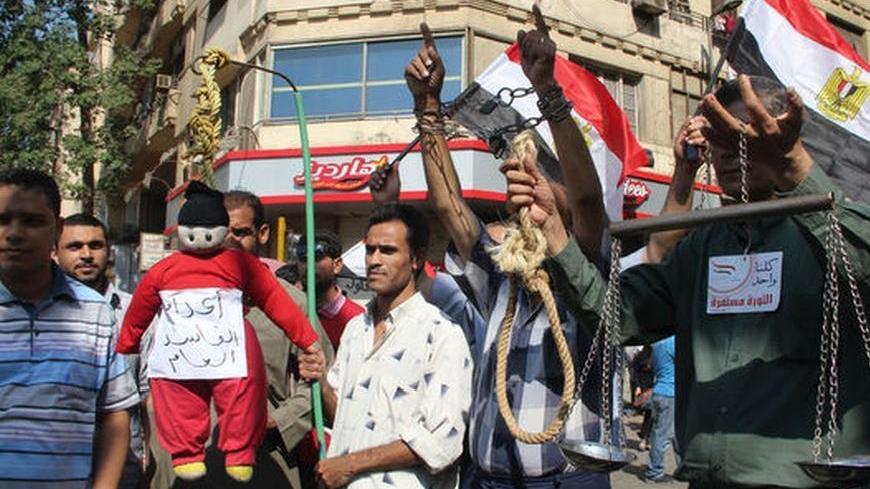
As in many Tahrir demonstrations, the opposition groups that called for protests at the palace starting Tuesday had clear political demands including the repeal of Mr Morsi’s constitutional declaration and the delay of the referendum. On the ground, many protesters went so far as to call the president himself the problem and demand that he step down.
Those initial demonstrations succeed in recapturing the nation’s attention. The sight of tens of thousands of protesters marching through the normally calm streets of Heliopolis overshadowed the lingering occupiers and tents in Tahrir.
Deadly clashes on Wednesday between opponents and supporters of Mr Morsi galvanized the palace area as the revolution’s newest front, with its accompanying partisan connotations. The conflict came down to a crisis of legitimacy, with opponents claiming Mr Morsi lost it when he overstepped the legal bounds of his position and supporters insisting that nothing could change the fact that he was elected by 51% of voters.
By Thursday, the violence had ended but not without leaving an indelible mark on Egypt’s transition.
Hesham Mostafa, a 50-year-old accountant, lives down the street from the palace and says he voted for Morsi.
“The time has passed for Morsi to go back on his word,” he said. “Morsi will leave but after a sea of blood.”
Less than five days after this round of protests began, Morsi backed down from his constitutional declaration but insisted on the timing of the referendum. His latest announcement came after a dialogue that included none of the key opposition groups and made no reference to the protesters, suggesting that his authority comes from neither Tahrir nor any other street in Egypt but from within the palace itself.
By Sunday, opposition groups such as
Sixth of April called for demonstrations in front of the palace to continue, describing Morsi’s concession as “a political maneuver aimed at duping the people.”
Stephen Kalin is an independent journalist based in Cairo. Follow him on Twitter @6thFloor_Cairo.
AL-MONITOR All-Access gives you unlimited access to all our journalism, the full Daily Briefing, exclusive interviews, premium newsletters, and live events — for less than $2/week.