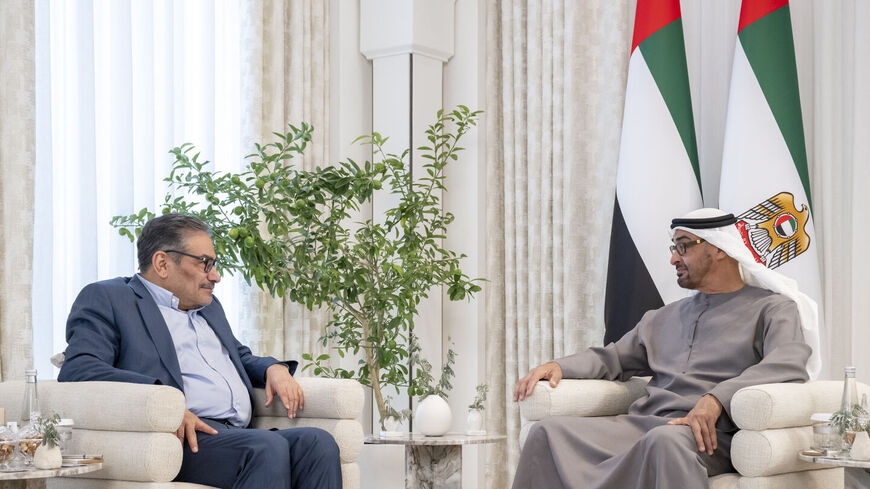
The United Arab Emirates (UAE) has recently been the scene of diplomatic activity, the most prominent being the visit by Iranian Foreign Minister Mohammad Javad Zarif to the capital, Abu Dhabi, and the emirate of Dubai on April 15. During his visit, Zarif took part in the second Iranian-UAE joint high commission and met with his Emirati counterpart, Abdullah bin Zayed, as well as with Prime Minister Mohammed bin Rashid Al Maktoum, to whom he delivered an official invitation from President Hassan Rouhani to visit Tehran. This is the second such invitation extended to a high-ranking Emirati official, the first having been extended in December to UAE President Khalifa bin Zayed Al Nahyan.
UAE Foreign Minister Abdullah bin Zayed, who visited Tehran in November, went so far as to describe the Islamic Republic of Iran as a “strategic partner” and noted that the UAE-Iranian “relationship was not limited to trade and economic affairs, but transcended those to include cultural common bonds.” Both countries have strong, wide-ranging business partnerships, but according to bin Zayed, the “volume of trade exchange between them a few years ago amounted to more than 44 billion AED [$12 billion] per year, [before] retreating in recent years to approximately 25 billion AED [$6.8 billion] in 2012.” This decline resulted from the economic sanctions imposed on Iran and the UAE’s deference to international resolutions in this regard.
Both countries are trying to expand their economic ties, especially given that if sanctions on Iran are lifted, Emirati ports, in particular Dubai, will become a main gateway for the transport of goods between Iran and the rest of the world. This would result in a faster economic recovery for Iran and bolster both countries’ mutual interests. This scenario was explicitly mentioned by Sheikh Mohammed bin Rashid, ruler of Dubai, who told the BBC in January, “Iran is our neighbor, with whom we do not want any problems. Lift the sanctions and everyone will benefit.” Foreign Minister Abdullah bin Zayed reiterated this sentiment in Abu Dhabi on April 16, when he spoke of “great opportunities for mutual investments by the private sectors of both countries, once the hurdles imposed by international decisions are removed.”
The UAE has also been lightly stung by the sanctions on Iran. The sanctions mean Emirati banks cannot establish normal relations with their counterparts in Iran, with the UAE severing ties with 17 Iranian banks. The export and re-export activity from the port of Dubai toward the Iranian ports has also been affected. This is what makes the UAE unwilling to retreat or stop its trade relations with Tehran, as it stands to gain economically should sanctions be lifted. The economic incentive, added with the roughly 400,000 Iranians living in the UAE, places the UAE in a position to benefit should sanctions on Iran be lifted. In addition, economic interests can play a role in the soft containment of Tehran, rendering the latter more flexible in its foreign policies and positions, as well as bolstering the popularity of the reformist movement within Iranian society and decision-making circles.
AL-MONITOR All-Access gives you unlimited access to all our journalism, the full Daily Briefing, exclusive interviews, premium newsletters, and live events — for less than $2/week.