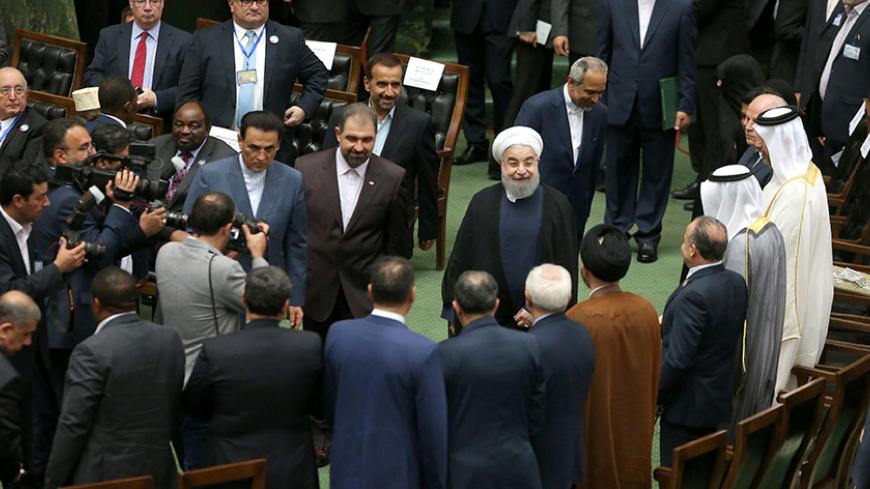
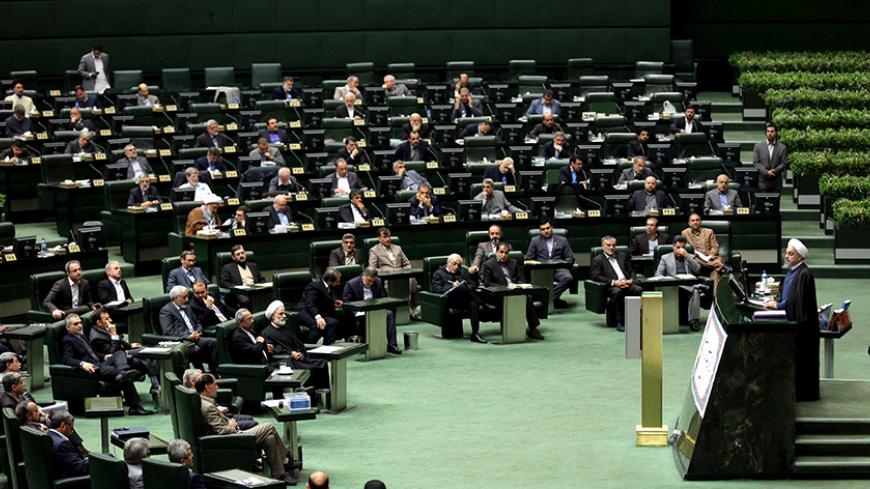
On Aug. 20, the Iranian parliament voted to approve all of moderate President Hassan Rouhani’s proposed ministers — except for one Reformist minister. This has drawn the ire of Reformist activists who now slam Omid (Hope), the sole Reformist faction in parliament, for its “disappointing” performance during the votes of confidence for Rouhani’s second-term Cabinet.
The only proposed minister who did not obtain a vote of confidence was Habibollah Bitaraf, a Reformist figure who served as energy minister during President Mohammad Khatami’s second term (2001-2005). This has led some Reformist activists to accuse Reformist members of parliament of blackmailing the proposed minister, claiming that Bitaraf refused to accept certain requests by parliamentarians. Javad Emam, a Reformist figure close to Khatami, tweeted Aug. 21, “[The] not giving a confidence vote to Bitaraf is the result of [his] honesty, being uncorrupt and his negative answer to the requests of the gentlemen T, V, H, N.” By “T, V, H, N,” Emam meant four senior members of the Omid faction, namely Gholamreza Tajgardoon, Mohammad Ali Vakili, Elyas Hazrati and Ali Nobakht.
However, Vakili denied this accusation and claimed that he did his utmost in favor of Bitaraf.
Moderate newspaper Jomhuri Eslami joined critics and slammed lawmakers for their attempts to gain concessions in return for their support for the proposed ministers. “The results of the parliament’s vote on the proposed ministers of President Rouhani for the 12th government indicates that the most independent and neutral proposed minister cannot win parliament’s approval, and as can be seen, being willing to cooperate [with members of parliament] is an important factor in gaining a vote of confidence,” argued Jomhuri Eslami on Aug. 21.
AL-MONITOR All-Access gives you unlimited access to all our journalism, the full Daily Briefing, exclusive interviews, premium newsletters, and live events — for less than $2/week.