Palestine elections chief: Vote ‘transparent’ despite war, restrictions
In an exclusive interview, Rami Hamdallah defended the transparency of recent Palestinian local elections while outlining the political and logistical barriers to voting in Gaza and East Jerusalem.
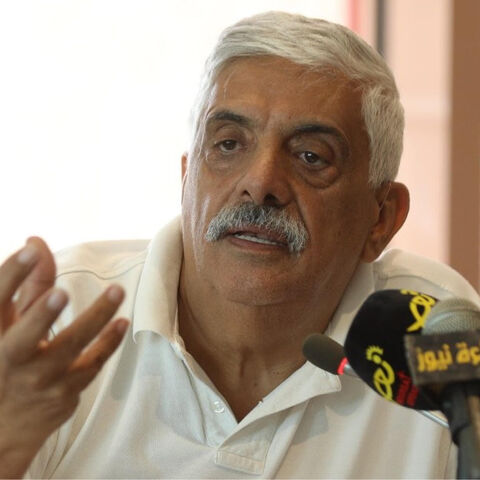
Welcome back to AL-MONITOR Palestine.
This week, we speak with Rami Hamdallah, former prime minister and chairman of the Central Elections Commission, about the integrity of recent local elections, the obstacles to voting in Gaza and East Jerusalem, and what it would take to expand participation in future Palestinian polls.
Thanks for reading,

Leading this week

Palestinian Prime Minister Rami Hamdallah attends a ceremony to mark the opening of a medical centre in the village of Beit Ula, north of the West Bank city of Hebron on Jan. 28, 2019. (HAZEM BADER/AFP via Getty Images)
RAMALLAH — In an extensive interview, Rami Hamdallah defended the integrity and professionalism of recent Palestinian local elections while acknowledging the immense pressures posed by occupation, war and movement restrictions. The chairman of the Central Elections Commission also outlined the political and logistical obstacles to expanding electoral participation in Gaza and East Jerusalem, arguing that while the electoral system remains technically sound, broader progress depends on political consensus and guarantees on the ground.
Hamdallah, a former prime minister, spoke to Al-Monitor in the only interview he has given to any media outlet since his appointment in April 2024. He firmly defended the independence and professionalism of the electoral process on April 25, saying, “The elections were conducted in accordance with the law and approved procedures and with the highest degree possible of transparency.”
He pointed to what he described as a robust framework designed to ensure legitimacy, including a published voters’ registry, the right to file challenges, the accreditation of more than 2,500 observers and 860 journalists, and the participation of 7,900 representatives of electoral lists and candidates. He added that results were announced according to official counting protocols, with ballots publicly counted and tabulated at polling centers.
“We did not merely announce that the process was fair and honest,” he said. “These qualities were embedded in clear procedures — transparency in polling, counting and the formal publication of results.” Yet he tempered that optimism with realism, acknowledging that the Palestinian political environment is far from normal due to occupation, ongoing conflict and movement restrictions that complicate the broader electoral landscape.
Discussing ways to expand participation, Hamdallah warned against treating the issue as purely technical, saying that any approach must take political realities and the broader framework of Palestinian governance into account. He expressed openness to “innovative participation mechanisms,” but he said they must remain inclusive, credible and backed by Palestinian national stakeholders.
He described the challenge as twofold: ensuring Jerusalemites can participate in Palestinian institutions while safeguarding what he called core national principles and legitimacy. “We are open to innovative participation mechanisms as long as they are inclusive, credible and endorsed by Palestinian national stakeholders,” he said. “I think that the time is ripe for overcoming this challenge so that the planned Palestinian National Council elections can move forward despite all obstacles.”
Hamdallah also addressed the feasibility of expanding elections beyond local councils to the legislative level — which has not been held since 2006 amid a long-running political impasse — as well as the broader challenge of organizing voting in Gaza. He argued that any national election — whether presidential, legislative or for other governing bodies — requires both a clear political decision and conditions on the ground that guarantee freedom of nomination, campaigning, polling and observation.
He described war, siege, movement restrictions, destruction, displacement and security concerns as deeply interconnected obstacles. Hamdallah said the West Bank, East Jerusalem and the Gaza Strip must all be included in any national vote, emphasizing that political consensus and guarantees on the ground are essential for credible and comprehensive elections.
Looking ahead, Hamdallah spoke candidly about the possibility of transitioning to direct mayoral elections in some contexts. While he acknowledged potential benefits — including greater accountability to voters and stronger legitimacy for local leaders — he also warned of possible drawbacks such as friction with council majorities and the need for broader governance reforms. He said the final decision rests with legislators and political stakeholders, with the CEC serving in a technical advisory role informed by its electoral experience.
The interview conveyed a clear message: The CEC sees itself as prepared, technically capable and committed to transparency and fairness — even as it grapples with occupation-related disruptions, wartime destruction and political sensitivities. The question of Jerusalem remains central — one that will require political consensus and careful compromise if Palestinian leaders hope to advance a broader and more inclusive electoral process.
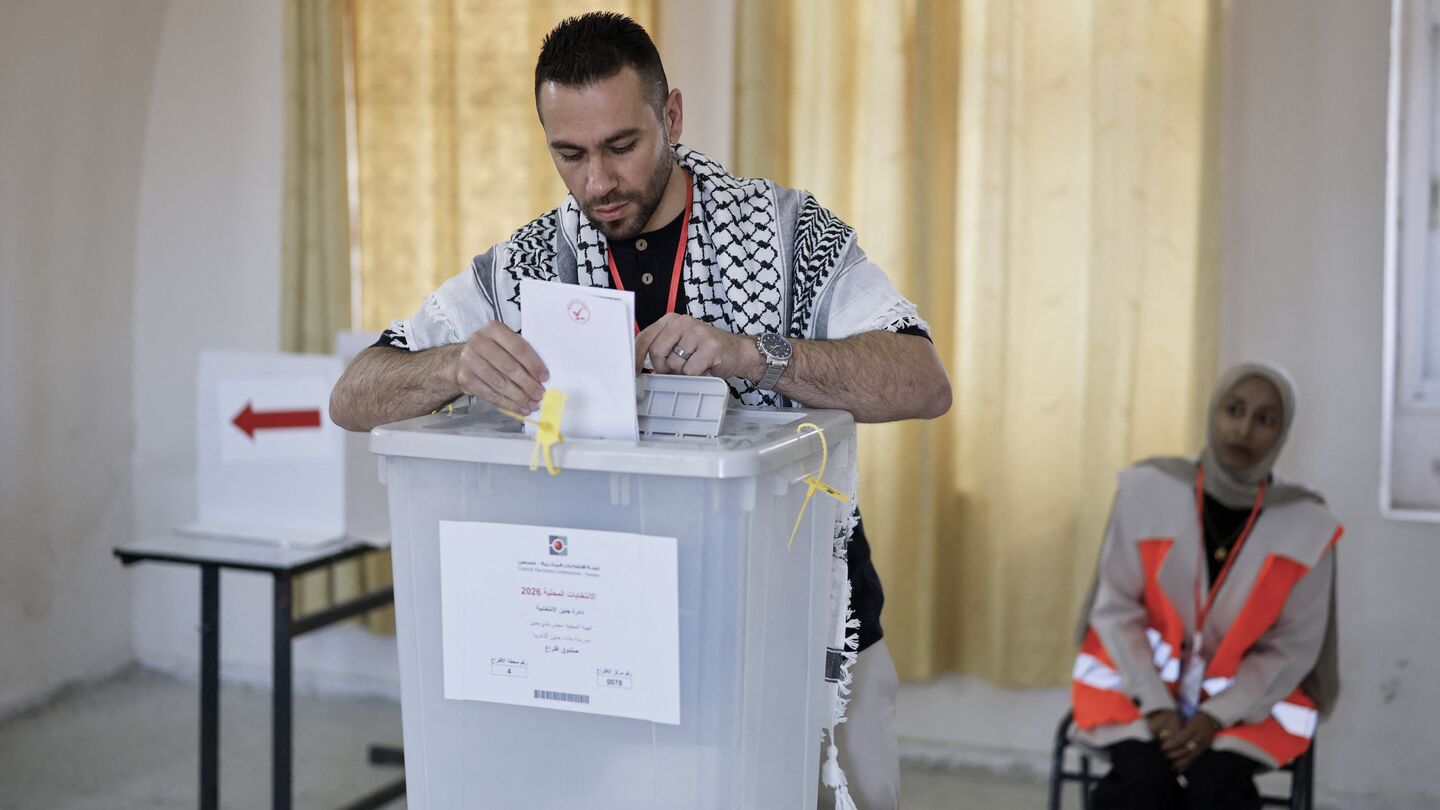
A Palestinian man casts his vote during municipal elections in the Israeli-occupied West Bank city of Jenin on April 25, 2026. — Marco Longari / AFP via Getty Images
Asked about the main challenges posed by the occupation, Hamdallah pointed to restrictions on freedom of movement, access to voters and the entry of electoral materials and personnel. “In the West Bank, checkpoints, incursions and closures impede inter-governorate travel, while in the Gaza Strip, the war’s impact — destruction, displacement and restrictions on the entry of materials — has magnified those difficulties,” he said.
He cited Deir al-Balah — the only Gaza constituency where voting ultimately took place — as a case in point. “It was not only about opening polling stations; it was a test of our ability to organize an electoral process in a war-torn environment,” he said. Despite these obstacles, Hamdallah said, the CEC leveraged available resources and succeeded in delivering a credible process.
The decision to include Deir al-Balah in voting was hailed as politically and institutionally significant, signaling a return to Gaza after two decades of disruption. Hamdallah enumerated the challenges, citing “widespread displacement, infrastructure destruction, schools repurposed as shelters, electricity shortages, communication gaps and entry restrictions on electoral materials.” He also pointed to a measurable outcome, noting "a turnout of roughly 23% in Deir al-Balah — low by broader standards but, in the context of war and displacement, viewed as a major achievement.”
In a follow-up question, Hamdallah stressed that the CEC remains technically ready to organize elections anywhere that meets essential criteria — including security, freedom of movement, the availability of polling centers, citizen accessibility and the entry of materials — treating Gaza not as an exception but as an integral part of the Palestinian electoral system.
On overall turnout, Hamdallah said participation stood at about 56%, describing it as significant given current conditions and broadly comparable to previous local elections (58% in 2021 and 53.9% in 2017). He said turnout tends to be higher in smaller municipalities where personal ties and service-related issues are more immediate, while major cities often see lower engagement due to broader political considerations and perceptions of limited competition.
In Gaza, he attributed lower turnout to war-related realities, limitations in the civil registry and widespread displacement, adding that “we do not see turnout as a statement about legitimacy but as a reflection of extraordinary circumstances.”
The interview also touched on the issue of acclamation, where 40 municipal councils and 155 village councils were formed without a vote because only one list or candidate stood, effectively winning automatically. While legally valid, such outcomes raise questions about the level of democratic competition. Hamdallah emphasized that the CEC’s role is to enforce the law and ensure fair procedures; it does not create or suppress competition. He noted that acclamations have been common in past elections, including 162 councils in the first phase and 23 in the second phase of 2021-2022, suggesting a broader pattern in which political realities and party dynamics shape outcomes. In major cities such as Ramallah and Nablus, he said, gaps in competition reflect broader political dynamics and the choices of local communities rather than any mismanagement by the CEC.
Addressing concerns about the accuracy of turnout figures, Hamdallah stressed that turnout is calculated using a standard technical formula: the number of actual voters divided by the number of eligible voters within the local municipalities participating in the elections. He described the process as transparent, with polling station protocols and station-level results compiled and verified in the presence of local and international observers, as well as agents representing electoral lists and candidates. He cautioned that misinterpretations often arise when local figures are compared with Palestine-wide population totals or when jurisdictions that did not hold elections are included in the calculations. Hamdallah added that the CEC welcomes criticism, provided it is grounded in sound statistical and legal methodology.
He also addressed the absence of elections in Jerusalem, a long-standing point of contention in Palestinian governance, noting that while some Jerusalem suburbs held local elections in 2026, participation for Jerusalemites remains as much a political and sovereignty issue as a technical one. He said that Palestinian participation in Jerusalem’s electoral process had been possible in 1996, 2005 and 2006, but that restrictions resurfaced in 2021, leading to the postponement of national elections.
This one's on us.
The story doesn't end here.
Our correspondents are already on the next chapter. Read everything they file, from $2/week.
See Offers