China cuts deal with Houthis, adjusts for long US war with Iran

Hi readers,
As the US-Israel-Iran war enters its sixth month, China is working behind the scenes to mitigate its economic costs and adjust for a prolonged conflict. The disruptions at the Bab el-Mandeb and Hormuz straits have sent shock waves through global oil markets. China, however, has maintained access to Middle Eastern crude through two distinct channels: Saudi oil has reached China on Chinese-linked tankers transiting waters blockaded by the Houthis, while Iranian crude has moved toward China through ship-to-ship transfers and oil stored aboard vessels off Malaysia.
The result is a resilient supply network for Beijing that has helped keep Chinese refineries supplied even as other operators reroute vessels and absorb higher insurance costs.
Let’s unpack!

Leading this week
Chinese-linked tankers pass Bab el-Mandeb. Two supertankers, the Xin Long Yang and Cosnew Lake, exited the Red Sea through the Bab el-Mandeb Strait on July 23 carrying a combined 4 million barrels of Saudi crude, according to Reuters, citing LSEG shipping data. Both vessels reported the crews as Chinese through their automatic identification system signals, although only the Cosnew Lake was Chinese-flagged.
Reuters said the vessels had avoided a Houthi blockade targeting Saudi oil shipments. Two other China-bound vessels subsequently used the route. The Hong Kong-flagged New Explorer exited the Red Sea carrying Saudi and Emirati crude for Ningbo, while the New Pearl carried 2 million barrels of Saudi crude toward Zhoushan, according to shipping data from Kpler and LSEG.
On Tuesday, Reuters reported that China has held direct talks with the Houthis "to enable its tankers to sail through the southern Red Sea without being attacked after the Iran-aligned militia pledged to prevent access to Saudi ports."

This photo taken on June 6, 2023 shows a cargo ship loaded with containers berthing at Zhoushan port in Ningbo, in China's eastern Zhejiang province. (Photo by CN-STR / AFP via Getty Images)

➡️ The tactic is systematic, not accidental. The Houthis previously established an application system allowing selective ship passage through the strait, with crews emailing requests days in advance; Iran is trying to impose a similar formalized system on traffic through Hormuz.
As of Tuesday evening, multiple oil tankers traversing Bab el-Mandeb were broadcasting their links to China on their automatic identification system transmitters. That came shortly after news surfaced that China has been holding direct talks with the Houthis to enable its tankers to sail through the contested waters of the Red Sea without being attacked.
With China particularly, there is precedent. Bloomberg reported in 2024 that the Houthis told China and Russia their ships could sail through the Red Sea and the Gulf of Aden without being attacked, following talks with top Houthi political figure Mohammed Abdel Salam.
Across the Arabian Peninsula, the resumption of a US blockade and the threat of Iranian attacks have impeded tanker transits at the Hormuz Strait. That hasn’t stopped China from importing Iranian oil by drawing on a floating reserve off Malaysia that has been available throughout the war — an established channel that circumvents US sanctions, according to Reuters, Kpler shipping data and The Wall Street Journal.
Tankers from Iran unload oil onto vessels off Malaysia that continue onward to China. One Iranian tanker, the Humanity, arrived off Malaysia last weekend, according to ship-tracking data reviewed by Reuters.
➡️ Even with the Iran war, China is still the top customer for Iranian oil while also buying from Saudi Arabia. Iranian oil arriving in China declined from a high of 1.7 million barrels a day in March to 785,000 in June and 523,000 in July after the war, per Kpler. Yet the share of Iranian crude in China’s total imports climbed to more than 24% in May and 18% in June, according to Vortexa.
Beijing is preparing for a long war. Reuters reported on Wednesday that Iran is expected to receive its first shipment of up to 400 Chinese-made shoulder-fired air defense missiles within weeks under a reported $60 million to $70 million deal. The purchase would help Tehran rebuild its short-range air defenses after months of war with the United States and Israel. China denied the report, and a spokesman for the Chinese Foreign Ministry called it "groundless."
Joyce's take: China’s ability to work around choke points shows the benefits of Beijing’s longtime position as both a financial lifeline to Iran and a critical customer of its rivals — for example, Saudi Arabia.
China is cutting its own deals and gaining wartime leverage as the Trump administration scrambles to reopen Hormuz. Beijing is securing safe passage through Bab el-Mandeb, snagging Iranian oil off Malaysia and preserving access to cheap crude in a manner that strengthens its strategic advantage.
After cutting imports during the war and helping the global economy weather Hormuz disruptions, China’s demand trajectory is now the key variable traders and policymakers are watching. In the coming months, all eyes will be on whether Chinese oil demand rebounds — and how quickly. Either way, Beijing’s next moves are poised to ripple through global markets, even as it continues to stay a step ahead.
Al-Monitor's Sam Wendel contributed to this newsletter.

Photo of the week
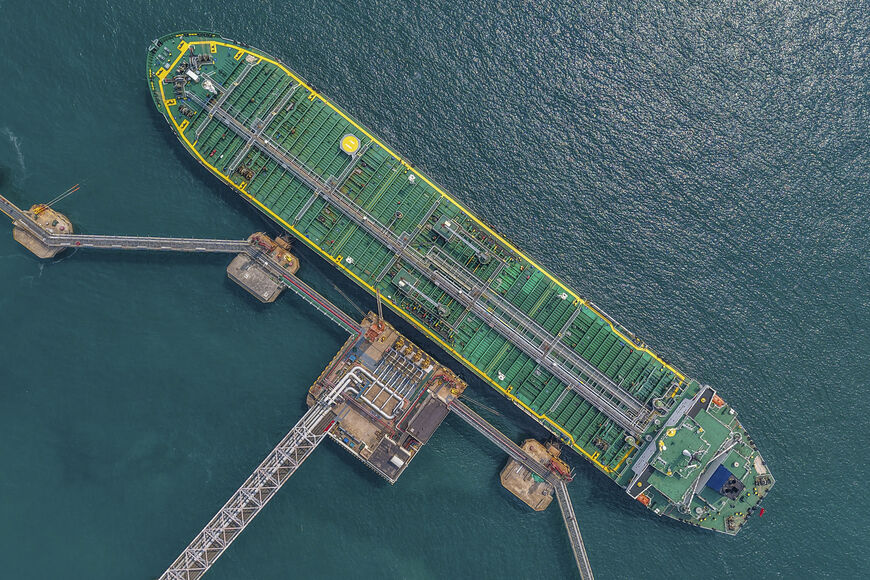
This aerial photo shows a tanker unloading imported crude oil at a terminal port in Qingdao, in China's eastern Shandong province on June 25, 2026. Photo by CN-STR / AFP via Getty Images

Deals and visits ✈️
- China’s Gotion wins $114 million African Development Bank loan to develop EV battery factory in Morocco
- Libyan deputy PM holds talks with Chinese ambassador
- Chinese, Egyptian FMs meet on sidelines of ASEAN summit
- China’s UN ambassador calls for Israeli withdrawal from Syria
- Two Chinese tankers carrying Saudi oil exit Red Sea
- Libya joins China's Cross-Border Interbank Payment System
- Arab Organization for Industrialization, China Electronics Technology Group Corporation sign agreement to make telecoms equipment in Egypt
- Chinese officials meet with Turkish deputy foreign minister
- Egypt’s Masdar City Free Zone opens two new offices in China
Thanks to Al-Monitor's Rosaleen Carroll for preparing this section.

What we are reading
- How Trump’s Iran "own goal" is hitting long-term US strategy to contain Chinese influence: SCMP
- US looks to boost anti-China spending worldwide by hundreds of millions, documents say: AP
- City in final China negotiations to bring giant pandas to Honolulu Zoo: Hawaii News Now
This one's on us.
The story doesn't end here.
Our correspondents are already on the next chapter. Read everything they file, from $2/week.
See Offers