Saudi artist Abdulnasser Gharem challenges power in Berlin
Also this week: Bahraini flavors, prize-winning art and Red Sea soundscapes

Welcome to AL-MONITOR Riyadh.
Even as Saudi Arabia navigates a fragile regional security landscape, its cultural scene continues to command attention at home and abroad. In Berlin, pioneering Saudi artist Abdulnasser Gharem is presenting a solo exhibition at Galerie Nagel Draxler examining the politics of imagery, institutional power and soft power across borders. Back in the kingdom, design platform Art Dom returns to Riyadh next month for its second edition, while Ithra is exhibiting works by the five finalists for its seventh Art Prize ahead of the winner’s announcement later this month. And for a taste of the Gulf after a day of art, Villa Mamas offers delectable Bahraini fare right in the heart of the Gulf.
If you want to receive this newsletter or our other City Pulse editions — including Dubai, Istanbul and Doha — sign up here.
Happy reading,
Rebecca
P.S. Have feedback or tips on Riyadh's culture scene? Send them my way at contactus@al-monitor.com.

1. Leading the week: ‘The Image is a Public Menace’

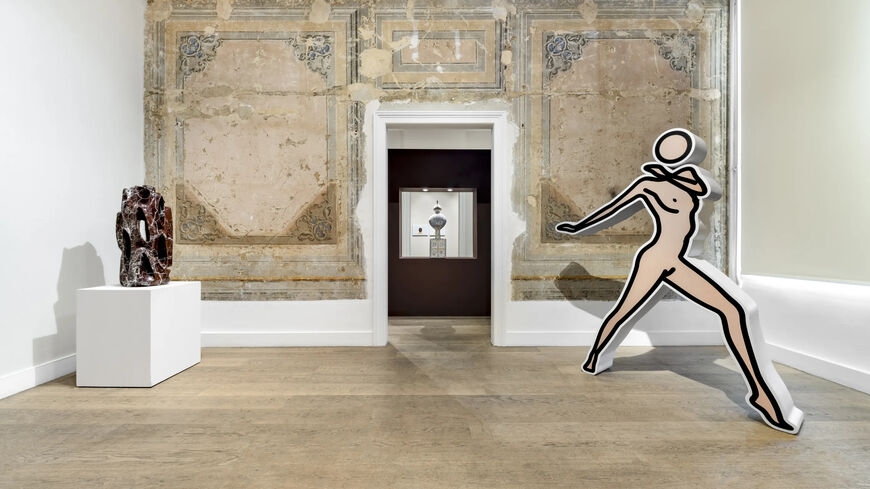
A view of ‘The Image is a Public Menace’ by Abdulnasser Gharem at Nagel Draxler Galerie. (Photo courtesy of Galerie Nagel Draxler)
Pioneering conceptual Saudi artist Abdulnasser Gharem is staging a solo exhibition at Galerie Nagel Draxler in Berlin. The artist, who was born in 1973 in Khamis Mushait and is a former lieutenant colonel in the Saudi army, is presenting three new projects: “Aniconism” (2026), “The Unscored Goal” (2026) and “The Image is a Public Menace (Neon)” (2026).
As one of the Gulf’s most influential contemporary artists, Gharem is renowned for his socially charged works that bridge diverse disciplines. Through a variety of mediums — including conceptual installations, sculptures, paintings and public interventions — he examines core issues of power, faith, societal evolution and identity within contemporary Saudi Arabia. Operating within a historically isolated yet rapidly modernizing cultural environment, he routinely pushes the boundaries of traditional artistic expression.
“This exhibition asks what happens when power no longer simply fears the image, but learns to manufacture, circulate and profit from it,” Gharem told Al-Monitor. “Across the works, censorship, absence and spectacle emerge not as opposites, but as different ways of controlling what can be seen — and what must remain unspoken.”
Gharem’s multimedia installation “Aniconism” (2026) offers a reworking of traditional history painting, examining how cultural imagery is created, authorized and transferred between different societies. The term “aniconism,” coined by German art historian Johannes Adolph Overbeck in 1864, refers to the practice of avoiding visual representations of sacred or living beings to prevent idolatry, replacing them with symbols or abstract shapes.
In 2015, Gharem bypassed regional restrictions by dismantling a female mannequin in Dubai and reassembling it in Riyadh. He then photographed a live reenactment of Martin Ferdinand Quadal’s 1787 painting, “The Nude Drawing Room of the Vienna Academy.” Gharem's resulting multimedia project features two large-format paintings alongside a video documenting this cross-cultural artistic process.
Gharem’s “The Unscored Goal” (2026) features a regulation size 5 football covered entirely in layers of official rubber stamps. Inscribed with everyday bureaucratic terms like "Approved," "Rejected," "Under Review" and "Confidential," these stamps encase the ball in symbols of authority and validation. By fusing a standard sporting object with tools of administration, the artwork explores the intersection of sport, sportswashing and bureaucratic systems. Ultimately, the transformation shifts the football from an instrument used to score points into a heavily regulated surface, suggesting that institutional systems may actively obscure the true goal itself.
Also on view is “The Image is a Public Menace (Neon)” (2026), a titular conceptual installation that integrates neon light elements to expand on the broader exhibition themes. In addition, select past works are also on view, including “Personal Holocaust” (2020). This piece presents a map of the Arab world alongside a close-up of Israel and Palestine, immediately evoking associations about the Israeli-Palestinian conflict, one of the world’s longest-running and most controversial conflicts.
Date: Until Nov. 14
Location: Galerie Nagel Draxler, Berlin, Germany
Find more information here.

2. Word on the street: Villa Mamas

A delectable Bahraini dish at Villa Mamas in Riyadh. (Photo courtesy of Villa Mamas)
For a homegrown, regional culinary concept, head to Villa Mamas on Bujairi Terrace. Here, chef Roaya Saleh serves soulful Bahraini home cooking, blending regional heritage with global influences. The shareable menu features mindfully sourced, high-quality ingredients from local and international organic producers.
Be sure to try the Lamb Mozat, made with tender shank served on fragrant vermicelli rice with pine kernels; the Chicken Tahchin, a signature Persian-infused layered saffron rice dish with tender chicken; Hamour Sayadieh, a classic spiced local fish over caramelized onion rice with rich tahini sauce; and Muhallabia, a creamy, comforting milk pudding scented with delicate rosewater.
Location: Bujairi Terrace, Riyadh
Find more information here.

3. Riyadh diary

A view of a public program during Art Dom Riyadh 2025. (Photo courtesy of Art Dom Riyadh)
- Art Dom Riyadh returns for second edition
Art Dom, an esteemed Russian art and design fair, is returning to Riyadh next month for its second edition under the direction of its founder Daria Zolotova. The fair goes beyond the traditional exhibition format, bringing together premium interiors, international design brands, collectible design, contemporary art, business dialogue and cultural programming within a single boutique platform. “This year’s edition will introduce design premieres, a dedicated collectible design and art zone, and a special screening of “Two Chairs” — a documentary about design, culture and identity featuring leading international voices in design and architecture,” Zolotova told Al-Monitor.
Date: Oct. 20-21
Location: Mandarin Oriental Al Faisaliah, Riyadh
Find more information here.
- 7th Ithra Art Prize exhibition
Works by the five shortlisted Arab finalists of the seventh edition of the Ithra Art Prize are on view at Ithra, the King Abdulaziz Center for World Culture, located in Dhahran, Saudi Arabia. As one of the Arab world’s most esteemed art prizes, the exhibition features research-driven contemporary installations, paintings and textiles from five finalists: Aseel Al-Yaqoub, Bady Dalloul, Heba Y. Amin El-Mahamly, Ala Younis and Jawad Al-Malhi. The grand prize winner, who will receive a $100,000 grant, will be announced on Sept. 27.
Date: Until Dec. 31
Location: Ithra, the King Abdulaziz Center for World Culture, Dhahran, Saudi Arabia
Find more information here.
- Hayy Sounds Listening Stations
Serving as the closing program for the “Red Wind, Coral Worlds” exhibition, this sonic installation is presented in collaboration with Frequency Room. The listening stations map the Red Sea region's vast geographic history through audio, vocal testimonies and rhythmic compilations. Highlights include Atiyyah Khan’s “Rotations of Bismillah” and the multi-artist project “Index of Edges” and regional compilations by Ostinato Records. Accompanied by a photographic display, the installation uncovers the rich, hidden sonic encounters connecting borders and generations.
Date: Until Oct. 26
Location: Hayy Jameel, First floor, Frequency Room
Find more information here.

4. Book of the week: ‘Shattered Lands’

In this pioneering book, author Sam Dalrymple explores how the Indian Empire once stretched across the Arabian Sea to encompass parts of the Middle East. Before fracturing into 12 different modern nations during the mid-20th century, the vast British Indian Empire held massive influence over the Gulf. During the height of the British Raj, large swathes of the Arabian Peninsula — including modern-day Yemen, Oman, the United Arab Emirates, Qatar, Bahrain and Kuwait — were legally administered or heavily integrated as part of Britain's empire in India.
Dalrymple notes that while territories such as Yemen, Oman, the UAE, Qatar, Bahrain and Kuwait were closely tied to British India, Saudi Arabia stood apart. His book, “Shattered Lands,” examines how — if these regions hadn't separated — most of the Arabian Peninsula could have potentially become part of India or Pakistan after independence. Using deep archival research and hundreds of first-person interviews across multiple languages, Dalrymple shows how borders drawn by bumbling politicians in London upended the lives of ordinary citizens, leaving a lasting legacy of division across Asia.

5. View from Riyadh

Saudi boys wave a national flag during a military parade marking the 96th Saudi National Day in Riyadh on Sept. 22, 2026. (Photo by Fayez Nureldine / AFP via Getty Images)

6. By the numbers
- The Ithra Art Prize awards $100,000 directly to the winning artist and up to $400,000 in additional funding to cover the production and presentation of the winning artwork.
- The prize received more than 500 submissions from across the Arab world for its seventh edition.
This one's on us.
The story doesn't end here.
Our correspondents are already on the next chapter. Read everything they file, from $2/week.
See Offers