Minister warns of Libya's division
Al-Monitor interviewed the Libyan undersecretary of the Information Ministry, Haitham al-Hadi Kamouka, who talked about some countries’ attempts to divide Libya into three states.
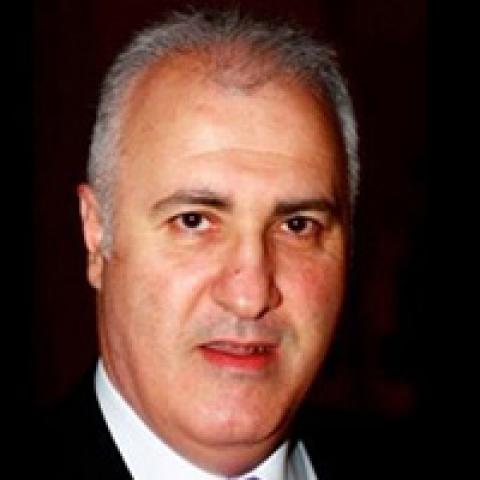

BEIRUT — Haitham al-Hadi Kamouka, the Libyan Information Ministry undersecretary — that is, the minister of the governing entity in Tripoli, Libya — visited Beirut on May 12-16 to meet with Lebanese officials. He came to convey his government’s view of the ongoing conflict in Libya. While here, he also issued a call to reporters to visit Tripoli. Al-Monitor met the minister to discuss the current situation and obtain some background on the major crises plaguing his country, many of whose citizens feel neglected, for more than four years now, after the revolution they and the world believed to be a success.
Kamouka explained that among the competing political actors, the National Salvation Government — which holds northwestern Libya, and of particular importance Tripoli Province, site of the capital — controls the largest amount of Libyan territory. Another force controls Cyrenaica in the east, including its capital, Benghazi, while in the south armed tribal forces, most prominently the Saif al-Nasr (historically known to cooperate with the French), control the Fezzan and its capital, Sabha.
Kamouka said, “The revolution that triumphed over the former dictator, Moammar Gadhafi, originally inherited the remains of a state. Libya lacks a state structure. It has no economy and no society. The only state apparatus was the police, and oil revenues were directly diverted to the leader, who distributed them to his subjects to ensure their silence and loyalty.”
The fundamental obstacle facing his government, Kamouka contends, is how to reorganize the public sector. “The government found that Gadhafi made more than a quarter of Libya's population into government employees to buy their loyalty and bribe them with high salaries in return for doing nothing,” he said. More than 1.5 million Libyans out of some 6 million total worked for what was called at the time the “State of Gadhafi.” The annual budget for government salaries exceeded $8 billion, which, according to Kamouka, still failed to buy an effective public sector or state.


