A confident farewell: Abu Dhabi Art’s last edition hits new peak before Frieze
In its final 17th edition before it becomes Frieze Abu Dhabi in 2026, the fair staged its largest showing and attracted local and international collectors alike.


Local Emirati and international buyers have been eagerly perusing the halls of the last edition of Abu Dhabi Art before it becomes Frieze Abu Dhabi in 2026. Its 17th edition, now in full swing, is the largest yet. The fair, which opened to VIPs on Nov. 18 and runs through Sunday, Nov. 23, features 142 exhibitors from 34 countries, up from just over 100 last year.
The mood is upbeat and optimistic amid gallery halls displaying art from across the Middle East and beyond, with Nigeria and Turkey highlighted in this edition’s "Focus" section.
Rising global interest
Noteworthy this year are the 53 new exhibitors, underscoring growing global interest in the Gulf’s art market. Among the newcomers are art world heavyweights like Pace Gallery, returning to the fair for the first time since 2011. It is presenting a small edition of Robert Indiana’s iconic "Love" sculpture, selling for $850,000, and new sculptures by Arlene Shechet for $120,000. Another new participant is Galleria Anna Marra from Rome, showing works by Italian artist Veronica Botticelli, Moroccan artist Khadija Jayi and South Africa's Turiya Magadlela, priced at $11,500 and under.
“I’ve long been keen to set foot in the Gulf market,” gallery owner Anna Marra told Al-Monitor. “While I have no contacts here yet, we have managed to sell five works. I also didn’t expect Abu Dhabi to be so culturally vibrant.”
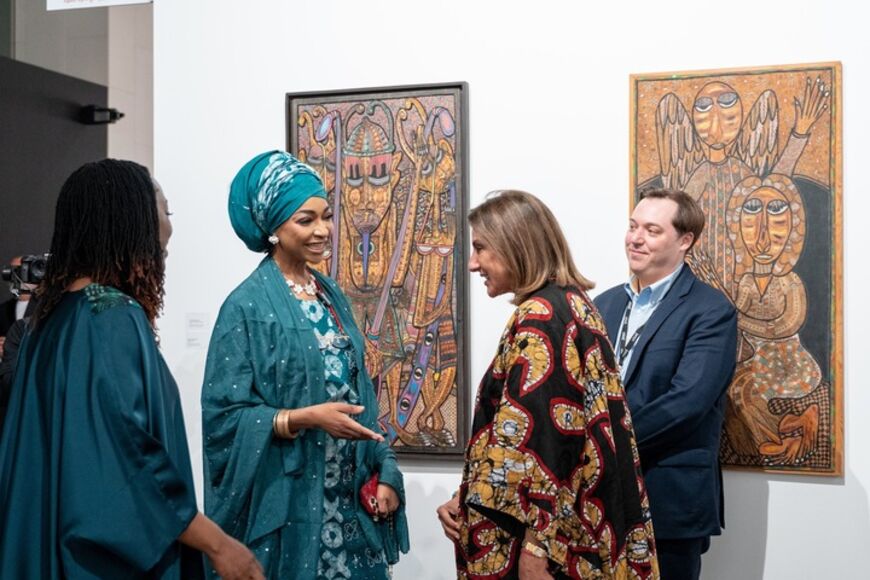
A view of kó artspace during the opening of Abu Dhabi Art, 2025. (Courtesy of Abu Dhabi Art)
Dyala Nusseibeh, the director of Abu Dhabi Art since 2016, says the fair has steadily expanded its appeal to different types of buyers.
“We’ve seen incredible growth in the range of collectors at the fair,” she tells Al-Monitor. “Last year, I noticed more buyers from the middle-tier bracket, which is slightly declining in traditional centers such as Europe and America and an important market segment. Lawyers, doctors and professors based in Abu Dhabi are coming to the fair to buy art for their homes here. We’ve also introduced works that are under $3,000.”
Cecile Attal, director of Perrotin, an international gallery with a space in Dubai and a regular participant at the fair, noted “a more international and engaged audience this year.”
One of this edition’s most expensive works was Shakespeare’s "First Folio," the first collected edition of Shakespeare’s plays, shown by Peter Harrington Rare Books. The rare volume attracted four potential buyers and sold for around $4.5 million to an international collector.
Printed in London in 1623 by Isaac Jaggard and Edward Blount, the "First Folio" is the foundational compilation of Shakespeare’s plays, preserving 36 works — including 18 that might otherwise have been lost forever. Without this volume, the world wouldn't have "Macbeth," "Twelfth Night," "Julius Caesar" or "The Tempest."
A fair in transition
Discussing Abu Dhabi Art’s transition to Frieze Abu Dhabi next year, Nusseibeh described the shift as an “evolution.” It will be the latest in a series of transformations: The fair launched in 2007 as ArtParis Abu Dhabi before coming under the umbrella of the Abu Dhabi Authority for Culture and Heritage (ADACH) in 2009 and being renamed Abu Dhabi Art Fair.
Despite becoming increasingly international with each edition, the fair has remained rooted in art from the Middle East and other regions that are historically overlooked by the Western-centric global art market.
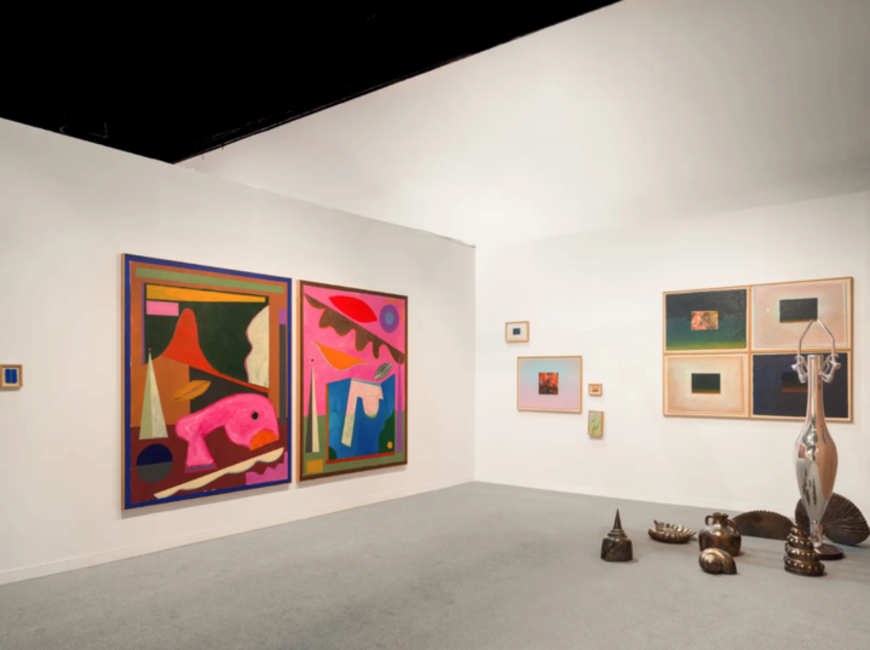
A view of the booth of Tabari Artspace during Abu Dhabi Art, 2025. (Courtesy of Tabari Artspace)
This year, that commitment is reflected in a strong African presence, especially works tied to Nigeria’s Osogbo School.
Nusseibeh stressed how crucial it is for the fair to show works from different regions to demonstrate the art market’s diversity.
“The fair builds in energy every year,” says Maryam Al Falasi, founder and director of Iris Projects, an art advisory and commercial art gallery that Falasi, originally from Dubai, opened in Abu Dhabi’s MiZA neighborhood, a growing cultural district in the capital.
Falasi’s gallery presented works by local Emirati artists. There was great interest in Shamsa Al Omaira’s works, which sold during the fair’s VIP preview, with the three works going for $10,000 each. Juma Al Haj sold a work for $16,000 to a corporate collection.
“There is a new wave of institutional curators visiting and an international press presence that arrives with real curiosity,” adds Falasi. “With Frieze on the horizon, I’m feeling genuinely optimistic. What stands out most to me in this edition is the enthusiasm from local collectors and the community that continues to champion regional talent, as well as a hunger for emerging or lesser-known artists. I’m also intrigued by how many first-time participating galleries are surprised to discover just how many significant collectors are not only in the city but actively present at the fair.”
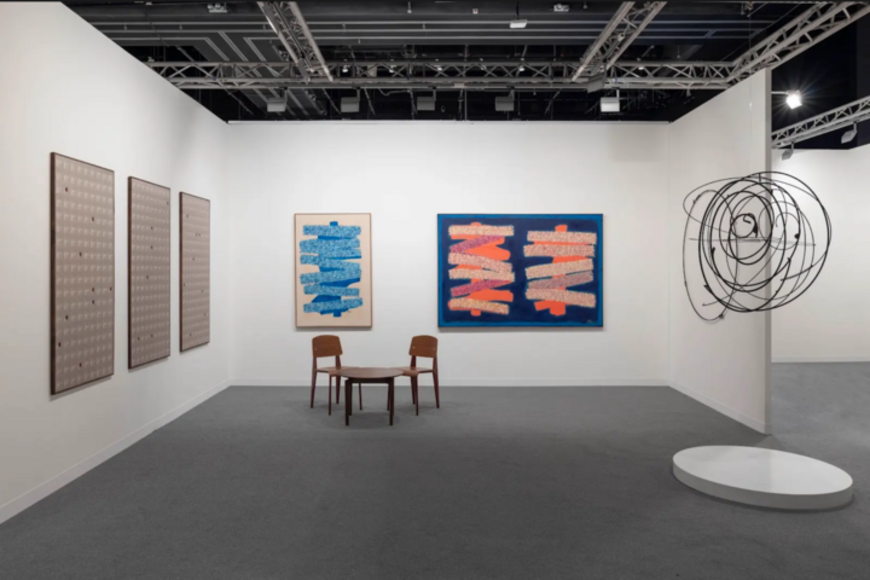
A view of the booth of Iris Projects at Abu Dhabi Art, 2025. (Courtesy of Ismail Noor for Seeing Things)
This year’s fair unfolds during what is arguably the busiest and most eventful Abu Dhabi Art week in history. Alongside the fair, the inaugural Nomad Abu Dhabi, a fair for collectible design and contemporary art, was staged; the National History Museum Abu Dhabi opened its doors on Nov. 22 to the public; the Zayed National Museum, opening Dec. 3, offered several private tours; and a wave of new gallery openings and exhibitions reflected a UAE capital in full cultural swing.
Residents and international art world figures flocked to Abu Dhabi to enjoy the buzz of the moment. However, the question is whether the Gulf region’s growing private pool of collectors can sustain the arrival of global art fairs in the region, Art Basel Qatar being another big player that will launch in Doha in February 2026.
Nusseibeh is optimistic. “I think there is a really interesting growth potential for a country with such a high GDP and where you have people with disposable income to spend,” she told Al-Monitor. “Now the time is just right.”
This one's on us.
The story doesn't end here.
Our correspondents are already on the next chapter. Read everything they file, from $2/week.
See Offers