Iranians crossing into Turkey haunted by regime crackdown more than war
Many Iranians crossing into Turkey suggest the regime’s deadly crackdown on recent protests, not the bombardment, is the trauma they cannot shake.

KAPIKOY, Turkey — Many Iranians crossing into Turkey say the trauma that still haunts them is not the war but the regime’s bloody crackdown on last month’s protests. Nearly two weeks of airstrikes have battered Iran, killing more than 1,200 civilians and hitting cities across the country — yet for many fleeing the violence, the memory of the protests’ brutal suppression remains more traumatizing.
The protests that began Dec. 28 grew into one of the largest waves of unrest since the Islamic Republic was founded in 1979. Security forces responded with a brutal crackdown between Jan. 8 and Jan. 9 that the US-based Human Rights Activists News Agency (HRANA) said killed at least 5,000 protesters. The group said another 17,000 deaths remain under investigation. UN Special Rapporteur on Iran Mai Sato said last month that the death toll could be as high as 20,000.
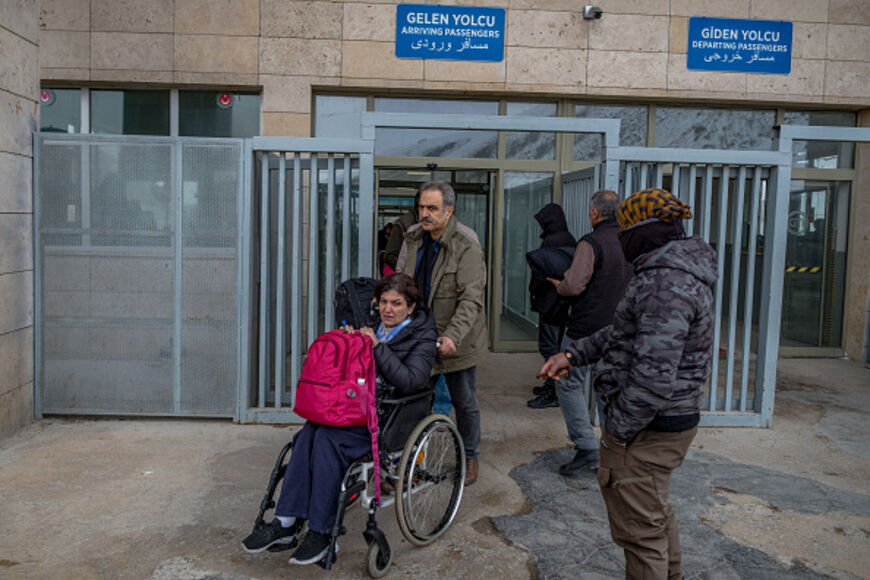
Many Iranians echoed similar sentiments as they crossed into Turkey earlier this week through the Kapikoy border gate, one of three crossings in Turkey’s Van province connecting the country to northwestern Iran. Among those who spoke to Al-Monitor was an Iranian university student, 21, who said she had come to Turkey seeking a brief respite from the war. “Khamenei was a murderer,” the university student from northern Iran said, referring to the slain Supreme leader Ayatollah Ali Khamenei. “He killed a lot of my friends. We are glad that he is dead. They must kill [Mojtaba Khamenei] too,” she added, referring to the former leader’s newly appointed successor, his 56-year-old son.
The woman said she would return to Iran after celebrating Nowruz, the Persian and Kurdish New Year, which is being celebrated on March 20 in Iran and March 21 in Turkey.
Iranian discos
Van has long been a popular getaway for Iranians, particularly secular, middle-class visitors from nearby cities such as Tabriz and Urmia. The Turkish province has developed a small nightlife economy catering largely to them, including clubs that locals call “Iran discos,” where alcohol flows freely, offering a temporary escape from the Islamic Republic’s restrictions on alcohol consumption, clothing and entertainment. Language is rarely a barrier: Many residents of Iranian cities near the border crossings are ethnic Azerbaijanis who speak Turkish.
The border has long attracted a more secular segment of Iranian society, which may partly explain why some travelers crossing there spoke with striking candor about the deaths of the country’s supreme leader and more than 100 senior officials.
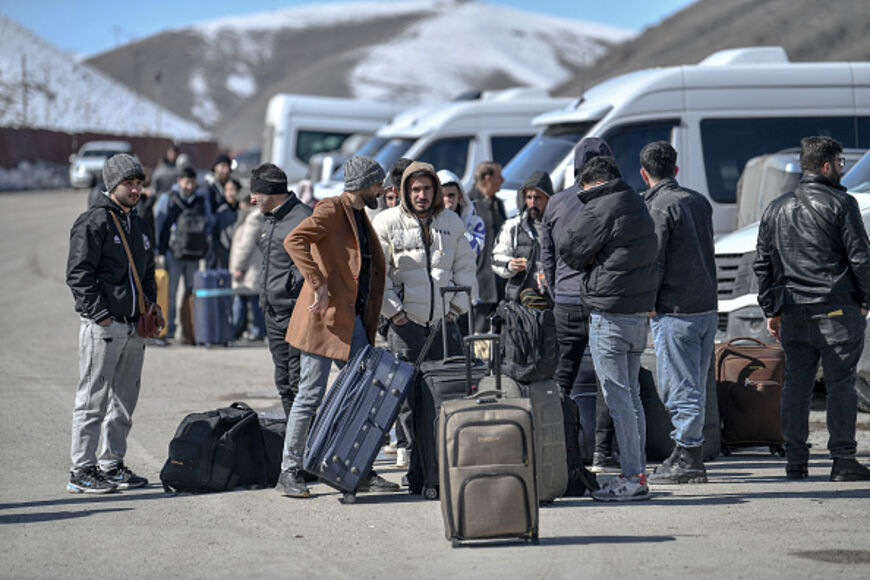
In addition to being utilized by Iranians seeking brief respite from the war, the Kapikoy crossing has become a route for foreign nationals fleeing Iran and for Iranian expatriates returning to the countries where they live amid the effective closure of the airspace.
Some cross simply to reconnect with the outside world during the nationwide internet blackout, using Turkish internet for work and to reach relatives abroad. Meanwhile, the blackout is also forcing others to return to the war-ravaged Iran to check on loved ones.
A group of young construction workers who work in Turkey’s earthquake-stricken region was among those returning. “I’ve not heard from my family for eight days. I don’t know if they’re dead or alive. I'm going to be with them,” one of them told Al-Monitor.
He added that he was “happy Khamenei had got what he deserved” for too many killings in his country. But he also opposes the war itself. “Israel and the United States shouldn’t be waging war on us,” he added. “Israel does not want what is good for us here in the region, for Muslims. If it did, would not it have killed so many people in Gaza?”
Others at the crossing voiced support for Iran’s fight against the United States and Israel, framing the conflict as a foreign assault on the country’s sovereignty and warning that it could plunge Iran into chaos.
Ali Muhammadian, 48, crossed Kapikoy to travel to Washington, where he lives, after visiting family in Tehran.
“It’s sad to see so many people believe that Trump and especially Israel would bring happiness to my country. It’s so naive,” Muhammadian said.
Muhammadian said he had criticized the Islamic Revolutionary Guard Corps before the war for its heavy-handed tactics, but now supports it for what he described as defending the country “effectively.”
He said he feared that if the regime collapsed, Iran could descend into the kind of chaos seen in countries such as Iraq or Libya, where US-led interventions to overthrow authoritarian rulers were followed by years of bloody internal conflicts. “I have a 5-year-old child living in Tehran,” he said.
The war has not affected every part of Iran equally. Airstrikes have repeatedly struck Tehran, while in the country’s northwest the impact has been more uneven, with many neighborhoods continuing on with their daily routines.
The university student said that for her, the war still feels distant. “People are outside, shopping, walking in the streets,” she said. “They don’t target us.”
Consensus on the Kurdish issue
Despite their divided views on the war and the regime, many Iranians at the crossing shared concern over reports that the United States and Israel could arm Iranian Kurdish groups to fight the government.
“If they do that, the Kurds would first kill us,” an ethnic Azerbaijani woman from northwestern Iran told Al-Monitor.
“We have always been one Iran, and we will remain one Iran,” she added. Asked how regime change could be possible without support from inside the country, she said Iranians could not take to the streets because the authorities would carry out another massacre.
“This time they would kill even more people,” she said. “They don’t need ground troops; they should just keep striking like this. In the end, they’ll be finished.”
The Kurdish issue is particularly sensitive in Iran’s northwest, where ethnic Azerbaijanis living in Iran and Kurds live side by side and occasional ethnic tensions have surfaced. Some Iranian Kurdish groups have long called for autonomy or federal arrangements.
“They want to use the Kurds as a tool for their own gains. But let them know well: The Kurds are not the same people as before who were easily deceived,” Behrouz Mohammadi, an ethnic Kurd from Urmia, told Al-Monitor at the crossing, referring to the reported plan to arm Kurdish groups.
Kurdish distrust of outside powers runs deep. After the 1991 Gulf War, US President George H.W. Bush encouraged Iraqis to rise up against Saddam Hussein. Kurdish and Shiite uprisings followed, but Saddam’s forces quickly crushed them while Western powers stood aside, sending hundreds of thousands of Kurds fleeing toward the Turkish and Iranian borders.
“Today, they want to fan the flames of war here. But as the Kurds of this region, we do not want our country to become a battlefield for others,” Muhammedi said.
“Let Netanyahu, Trump ... know well the people of Iran stand behind their leader,” he added, in reference to the new supreme leader.
This one's on us.
The story doesn't end here.
Our correspondents are already on the next chapter. Read everything they file, from $2/week.
See Offers