Cairo's new monorail glides above a city struggling below


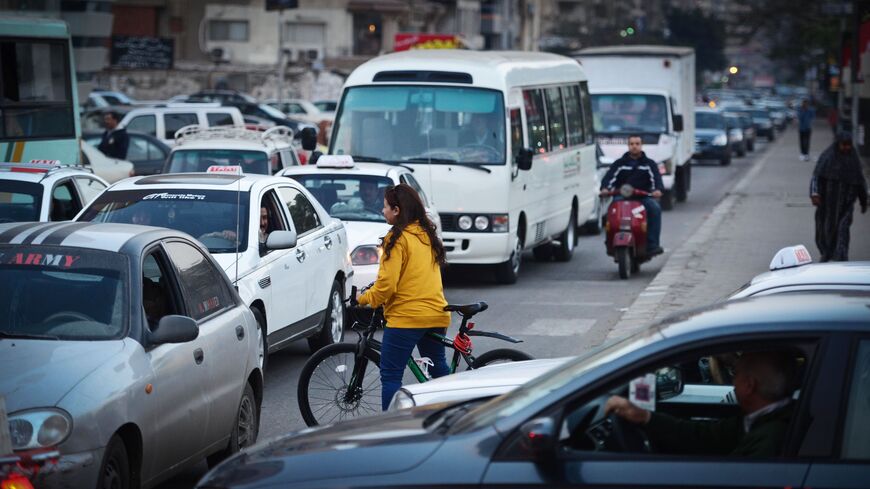
Cairo's new monorail slices across the city skyline, running above the familiar chaos of blaring horns and ageing buses' exhaust fumes that mark rush hour below.
The $4.5 billion monorail, opened this month, is among Egypt's most prominent new transport projects, part of a debt-funded infrastructure drive criticised for sapping state finances while bringing limited benefits to most of the country's 109 million people.
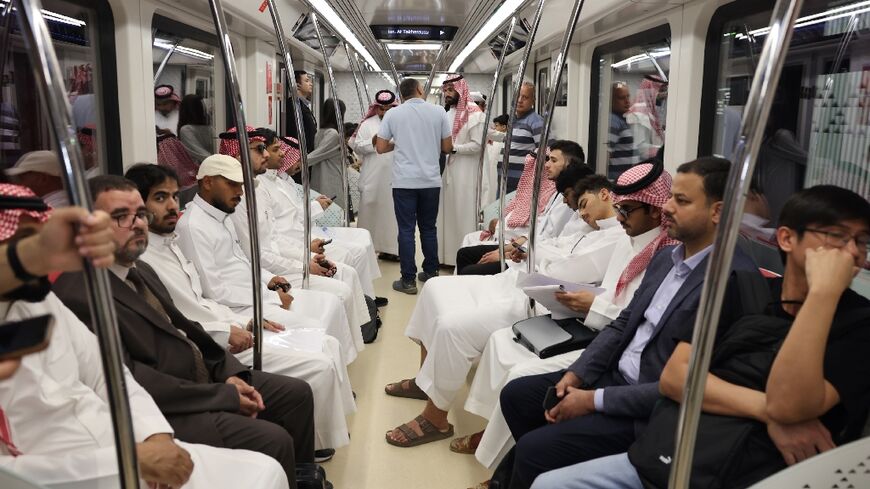
"It feels like you're in a different country," said Ramy Sayed, 44, aboard a driverless Innovia 300 train.
"No noise, no traffic, we're not used to this," the restaurant manager told AFP.
The eastern line runs 56 kilometres from the bustling middle-class district of Nasr City to the New Administrative Capital, a sprawling $58-billion megacity in the desert east of Cairo.
A second 43-kilometre western line, from the Nile's west bank to 6th of October City beyond the Giza pyramids, is under construction.
The government says the monorail will ease congestion, cut fuel consumption and attract foreign investment.
But critics say even at 45,000 passengers an hour, it will serve only a fraction of Greater Cairo's 26 million residents, most of whom still rely on buses, microbuses and the metro.
- 'Empty desert' -
At one end of the line in Nasr City, rush hour continues as usual.
Above ground, microbus drivers shout out destinations, while below commuters crowd into packed metro carriages.
"Of course, the monorail is clean and fast," Basma Hosny, 41, said while waiting for a bus. "But it doesn't really help me."
Osama Okeil, a transport engineering professor at Ain Shams University, said infrastructure "should follow where people actually are".
"You don't build transport for empty desert and expect demand to follow," he told AFP.
He said investment should have focused on overstretched systems, particularly Egypt's railways and buses, warning projects like the monorail that rely on expensive imported technology "can become a burden".
"Modern transport is about serving the largest number of people at the cheapest cost," Okeil said.
- 'Not for people like us' -
For Sayed, the monorail offers an easier, if costlier, commute to his job in New Cairo, where gated compounds, universities and office parks have spread over the past decade.
"Before, I had to take two microbuses," he said. "They were crowded and uncomfortable and sometimes they didn't even run on weekends. But here, it's not busy and the timings are fixed."
Tickets range from 20 to 80 Egyptian pounds ($0.38 to $1.53) -- around half a day's pay for many labourers -- and trains run from 6:00 am to 6:00 pm.
Khaled Nazeer, 22, who works at a cafeteria in the new capital, said he now pays "just 30 pounds" for his daily commute, instead of "70 or 80 pounds" for the microbuses.
He commutes to the new capital from Cairo every day, along with an estimated 50,000 government workers staffing President Abdel Fattah al-Sisi's megaproject -- the focal point of a wave of infrastructure projects that have reshaped Cairo in the past decade.
The city, with its glass skyscrapers, monumental government buildings and upscale housing, remains sparsely populated.
Prime Minister Mostafa Madbouly says about 25,000 people live there, alongside roughly twice as many commuting civil servants.
On a recent Friday, curious passengers rode the monorail to see it for themselves, filming as Cairo's dense concrete blocks gave way to sweeping boulevards and construction sites, against endless stretches of desert.
"I've only ever seen the new capital on TV," said 33-year-old trader Mostafa Mohamed of the emerging skyline.
"It looks nice of course, modern and organised, but it doesn't feel like it's made for people like us," added Ahmed Gomaa, also 33.