UAE's Gargash expects 'prolonged' war, calls for Iran-Gulf security talks
"We need a new mindset that these sort of discussions ... can happen at an Iranian-American level, it should also take place at an Iranian-Arab level," Gargash told Al-Monitor.


NEW YORK — Senior Emirati official Anwar Gargash called on Sunday for a strategic regional vision that places Gulf states at the center of security talks with Iran rather than on the receiving end of Iranian attacks while Tehran is holding negotiations with the United States. He also anticipates a prolonged war with Iran and a period of instability for Iranian society as the country turns the page on 37 years of Supreme Leader Ali Khamenei's rule.
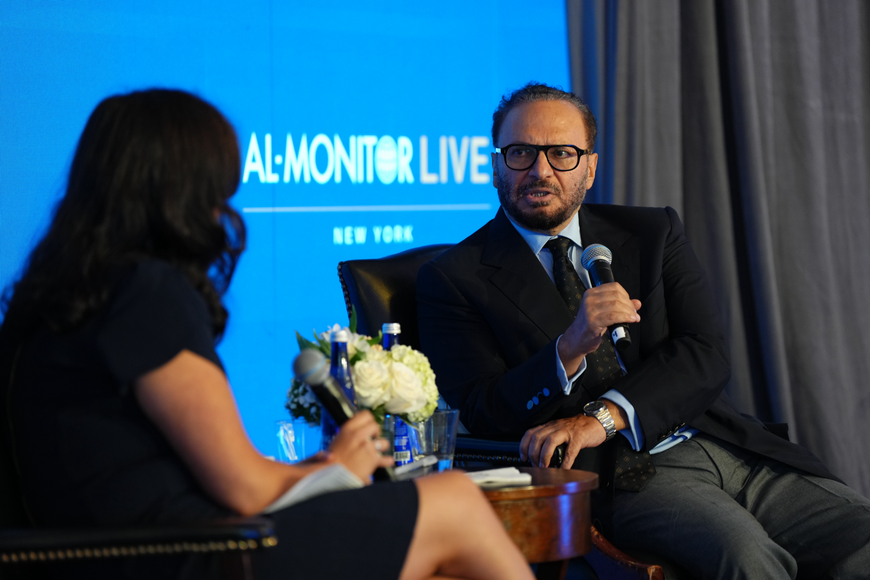
Gargash, a senior diplomatic adviser to Emirati President Sheikh Mohammed bin Zayed, spoke on Sunday with Al-Monitor's editor-in-chief at an event in New York about the UAE’s relations with Iran, how Abu Dhabi views the rivalry with Saudi Arabia, the conflict in Yemen and more.
"What I see is a prolonged conflict, not necessarily in the same sort of tempo, because if we really look at the conflict from the last year of February towards March and onwards, the tempos changed, but the conflict itself has continued," Gargash said of the ongoing US-Israel-Iran war, now in its seventh month.
The Emirati official described a time of uncertainty that could be marred with instability inside Iran, while stressing Abu Dhabi's interest in prioritizing diplomacy and good relations with its neighbor. "We have also realized that we will be dealing with with an unstable Iran for a period," he said.
"It is understandable that in a time of crisis, the party that actually holds … the gun or whatever is the dominant party," he said, referring to Iran's Islamic Revolutionary Guard Corps. "Ultimately we are looking at a crisis that will have different phases, but will take some time. We are also looking at an Iran that does not look like Iran in the last 37 years under one central authority of the Great Ayatollah Ali Khamenei."
He added that it will be difficult for new Supreme Leader Mojtaba Khamenei to “fill those shoes.” The elder Khamenei was killed in an Israeli strike in late February and succeeded by his son, who has yet to be seen in public since the war began.
The UAE official, who traveled to Tehran in 2025 and delivered a letter to Khamenei from US President Donald Trump about nuclear negotiations, called for a change of mindset on how to tackle regional security issues.
"The Iranians see themselves as a regional hegemon. They would rather discuss the strategic issues with the United States," he said, noting that Tehran likes to discuss transactional issues such as frozen funds with its neighbors. "We need a new mindset that these sort of discussions about what sort of region we all want, what sort of stability we all pray for and what sort of essentials of development — which is very much linked to stability, this sort of discussion — while it can happen at an Iranian-American level, it should also take place at an Iranian-Arab level," Gargash said.
"The region cannot move from crisis to crisis," he argued.
In July, the US and Iran last held direct talks, which provided a road map for a ceasefire as well as deliberations over Iran’s nuclear program and freedom of passage in the Strait of Hormuz. Iran continues to restrict passage through the waterway and the US naval blockade of Iran remains in effect.
Gargash said Iran must “compromise” in any new deal to end the war and declared that “non-belligerence” is especially important to the UAE. The Emirates has been disproportionately targeted in the US-Israel-Iran war that began in late February.
Gulf cooperation
Gargash downplayed the rivalry between the UAE and Saudi Arabia, saying, “The areas of interest between us and Saudi Arabia by far outweigh any sort of disagreements we have.”
The UAE and Saudi Arabia have diverged on a number of regional issues in recent years, most visibly in Yemen, where the Saudi-backed government seized areas held by the UAE-backed Southern Transitional Council separatists in January.
On the current conflict in Yemen, Gargash said, “We do ultimately need Yemeni-Yemeni dialogue” to solve the crisis.
The Iran-backed Houthis seized the entirety of Yemen’s Red Sea coast earlier this month, including the Yemeni side of the Bab al-Mandeb Strait. Saudi Arabia has been rerouting oil exports through the crucial regional waterway due to the disruptions in Hormuz.
Gargash said that efforts to boost cooperation between the UAE, Saudi Arabia and other states in the Gulf Cooperation Council have not had a positive impact amid the conflict, however.
“The influence of the Arab world and regional states has been minimal in this war,” he said. “We missed the opportunity of formulating an effective GCC position as we did in 1990 with Iraqi invasion of Kuwait.”
Gulf states had condemned the invasion and supported the US-led coalition that ultimately drove Saddam Hussein’s forces out of the country.
Gargash said the Gulf should “try again” on formulating a unified position in the current war, saying that speaking in unison would make the region “stronger.”
Syria and Lebanon
Gargash called Syrian President Ahmed al-Sharaa “pragmatic” and “rational” in his governance of Syria thus far, saying the UAE is committed to increasing investment in the country.
The UAE was originally cautious with regard to Sharaa, whose jihadist group Hayat Tahrir al-Sham overthrew former President Bashar al-Assad’s regime in late 2024. Despite its opposition to political Islam in the region, the UAE has recently increased its investment in Syria.
Gargash offered a similarly optimistic view of Lebanon in light of the senior Emirati economic delegation’s trip to Beirut last month.
“I think you have a determined president and prime minister and we trying to help where we can,” he said, referring to Lebanese President Joseph Aoun and Prime Minister Nawaf Salam.
On Israel, Gargash said the UAE is following the upcoming October elections and wants to see increased aid to Gaza, the disarmament of Hamas and no more Israeli settlements in the West Bank.
Israeli elections
Asked about the upcoming Israeli elections, Gargash said the UAE was concerned about the prospect of continued right-wing government policies in the occupied West Bank. “One of the things that concerns us is the sort of escalation that we might see because of right-wing government policies in the West Bank, and this for us will be really a problem in terms of dealing with this crisis,” he said.
Gargash said the UAE has leveraged its relationship with Israel to facilitate the delivery of almost $3.95 billion in aid to Gaza, calling the relationship “very strategic.” He also emphasized the UAE’s support for Trump’s 20-point plan, progress on which has largely stalled in recent months amid disagreements over Hamas’ disarmament.
This one's on us.
The story doesn't end here.
Our correspondents are already on the next chapter. Read everything they file, from $2/week.
See Offers