Why Strait of Hormuz no longer rattles oil markets as much: IMF
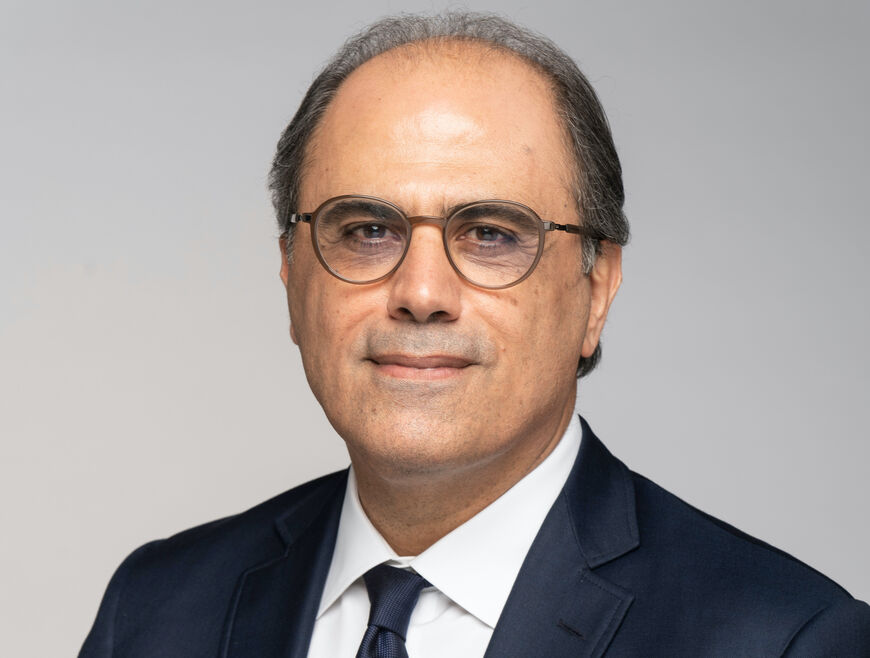
The fund's Middle East director, Jihad Azour, told Al-Monitor that the big Gulf energy producers now have more capacity to absorb the shock.


The oil market has become "less volatile" to disruptions in the Strait of Hormuz as some of the Gulf's largest energy producers have developed alternative export routes, according to Jihad Azour, director of the Middle East and Central Asia Department at the International Monetary Fund.
Saudi Arabia, the region’s largest oil producer, largely paused shipments from its Gulf export terminals at Ras Tanura and Juaymah in March after tanker traffic through the Strait of Hormuz plunged following Iranian attacks. The kingdom has since redirected much of its crude exports through its East-West pipeline to the Red Sea port of Yanbu.
The United Arab Emirates is also expanding alternatives to the strait. Logistics giant DP World plans to build a new port and container terminal on the country's east coast to reduce Dubai's reliance on Jebel Ali and bypass the Strait of Hormuz, the Financial Times reported Monday.
Despite a fragile ceasefire agreement that has been in place since April and a memorandum of understanding signed between the US and Iran on June 17 to end the nearly five-month war, violence flared up again last week after tankers were attacked in the Strait of Hormuz. The strategic waterway, which lies between Iran, Oman and the UAE, handled about one-fifth of global oil and liquefied natural gas (LNG) shipments before the conflict. Both Iran and the US have said they intend to control the strait and levy tolls on vessels transiting it.
In an interview with Al-Monitor, Azour said the expansion of alternative export infrastructure had helped cushion the latest supply disruptions, making oil markets less sensitive than they were at the start of the conflict. While a prolonged failure to reach a durable truce would still weigh on the global economy, he said the consequences were likely to be less severe than they would have been earlier this year.
“What has reduced the risks so far are the new channels developed to bypass the Strait of Hormuz, which allowed more supply to reach markets and reduced pressure on prices,” Azour said. “Supply has now increased, and therefore, despite the recent tensions we saw, the market's reaction is much less volatile than in the past. The main challenge still is the impact on prices and the risk of a pickup in inflation.”
Last week, the IMF cut its global economic growth forecast slightly from 3.1% to 3%, citing the conflict in the Middle East.
The following are highlights from the interview, lightly edited for clarity.
Al-Monitor: If a durable truce in the US-Iran war is not reached by the end of this year, what is the biggest downside risk to regional and global growth?
Azour: One has to separate between the regional outlook and the impact of an extended conflict on the rest of the world. Globally, the main transmission channel is the energy market and the availability of supply. What has reduced the risks so far are the new channels developed to bypass the Strait of Hormuz, which allowed more supply to reach markets and reduced pressure on prices. Supply has now increased, and therefore, despite the recent tensions we saw, the market's reaction is much less volatile than in the past. The main challenge still is the impact on prices and the risk of a pickup in inflation.
The rest is mainly a regional story. Clearly, for the MENA region, a long-standing conflict will increase uncertainty. It will definitely affect countries at the epicenter of the conflict, the oil-exporting countries, especially those that have little buffers and are already in a weak economic situation. Countries that have the capacity to use different channels or those that have a higher level of buffers will have the capacity to reduce the level of the shock. For example, for countries like Oman or Saudi Arabia, the downgrade was relatively limited compared to others like Qatar, Iraq or Iran, where the downgrade of growth is much larger.
Al-Monitor: What have you been seeing in terms of the recalibration of supply chains as a result of the conflict?
Azour: Of course, geography plays an important role. A country like Oman has access to the seas outside the Strait of Hormuz and has been protected from the shock. Countries that have built infrastructure to bypass the Strait of Hormuz, who have access to other channels, were also able to reduce the impact of the shock. Saudi Arabia is one with the oil pipeline. The UAE is another one, as it has a pipeline that allows it to increase crude exports. We have to take into account that global oil demand has adjusted. Demand has been reduced by almost 5 million barrels across the board, and new suppliers have come into the market. Therefore, countries that have buffers — both financial and institutional — and the right infrastructure will be faring better. Those who relied on the Strait of Hormuz and have not diversified their economy away from oil will be most exposed.
For example, more than 90% of Iraq’s exports are channeled through the Strait of Hormuz, and the country’s financial buffers are relatively limited, especially with the increase in public spending over the last few years. Other countries, like Qatar, are exposed because LNG is channeled through the Strait of Hormuz. Yet Qatar has diversified its investments in oil and gas, and it also has a high level of financial buffers.
Al-Monitor: Beyond oil exports, which transmission channels worry the IMF most in a prolonged disruption? What are the biggest risks that markets are still underestimating?
Azour: There are three main channels of transmission to countries, especially in the region: the flow of oil and gas, of course, remittances, and food, and this is why the impact is mainly felt by low-income countries and fragile states. And our projections for the summer show that after the Gulf countries, plus Iraq plus Iran, are the group that is the most affected.
Of course, here the issue also needs to be differentiated between countries that are highly dependent on energy imports from the Gulf, mainly Asian countries, and in terms of fertilizers, mainly low-income countries in Asia and in Africa, and the rest of the commodities. Therefore, we are in a situation where this level of uncertainty has been affecting countries, but the overall stability in the system has adjusted to this level of risk.
Al-Monitor: Which countries outside the Gulf are most exposed to a prolonged disruption in the Strait of Hormuz, and what factors determine their vulnerability?
Azour: Again, I think the question is the dependence on one source of supply and the level of reserves that have been created. Countries like Pakistan, Sri Lanka and Indonesia have high dependence on hydrocarbon imports from the region. Other countries, although they are large importers, have developed alternative sources, and they have built up reserves — countries like China, Korea and Japan. Therefore, here it's more the situation of the recipient country that will determine the impact. Of course, in terms of fertilizer exports, all countries that depend very much on this for their agriculture, and also are regularly affected by food security problems, will be more vulnerable. African countries, or countries that have already been facing fragilities in the region and beyond, will face two issues: One is the increase in price of fertilizers and food, and the second is the capacity to access supply, which in certain cases could be a problem.
Al-Monitor: Iran has weathered years of sanctions. If the maritime disruption persists and financial constraints remain tight, where would the economic pressure become most acute?
Azour: Iran has been negatively affected even before the war by the sanctions that had been brought up to the maximum level of pressure in the last few years. We saw the impact of this on increasing prices and hyperinflation and the massive devaluation in the economy. The Iranian economy has been going through negative growth over the last few years. Of course, this war will aggravate the situation. We expect, in addition to the destruction of some infrastructure, that economic activity will suffer, leading to a further drop in growth and higher inflation. It requires the right policies to rein in increasing prices and stabilize the macroeconomic situation.
Al-Monitor: In your latest economic outlook, the IMF mentions that if the recent surges in AI-related investments translate into wide deployment of technology and efficiency gains, medium-term global growth could strengthen. The Gulf has emerged as one of the world's leading investors in AI. How do you see that shaping the region's economic diversification and growth over the medium term?
Azour: There are two dimensions here in terms of AI: the adoption and the investment in terms of becoming a player, a producer of AI. Clearly, among the countries in the region, there are at least three countries that are in the top league in terms of readiness, and the level of investment has reached the level of advanced economies, mainly Saudi Arabia, the UAE and Qatar. Those are countries where AI has now become mainstream. Other countries are now accelerating this process, and the more we see investment in this, the more we see potential increase in productivity. Of course, there will be impact on labor, and this will become an issue of inclusion, especially for the youth. But in terms of economic activity, this will help accelerate the diversification, increase productivity and allow those countries to remain competitive.
The second dimension — which is more in the operational business — is that some of the countries were banking on access to cheap energy in terms of developing new data centers, and I think this is going to continue. But again, new technologies are emerging in terms of how to use other sources of energy, and also the geopolitical risk may delay some of those investments. However, especially mentioning the GCC countries, some of them have been heavily invested internationally in the US and also in Asia, and therefore the trickle-down of those investments is expected to benefit those economies in terms of diversification.
Al-Monitor: How long do you expect it will take before those overseas AI investments begin to deliver tangible economic benefits at home?
Azour: It depends on how this new industrial revolution will evolve, how fast this sector will become global, and who the winners and the losers are. Of course, this is one of the strategic bets that those countries, especially in the GCC, have put a lot of resources behind. But I think we need to wait a few years to see how this revolution will change our economies. For the rest of the countries in the Middle East, it is important to accelerate the adoption and improvement of their tech infrastructure, which will be a challenge for a certain number of low-income and middle-income countries in the region.
This one's on us.
The story doesn't end here.
Our correspondents are already on the next chapter. Read everything they file, from $2/week.
See Offers