Why China didn’t hand Trump a breakthrough on Iran
Trump's landmark three-day visit to China — the first for a US president since 2017 — included plenty of fanfare, flattery and awkward selfies but failed to produce deals or breakthroughs on Iran.



You're reading an excerpt from Al-Monitor China-Middle East, where we analyze China's deepening engagement with the region. To get this newsletter in your inbox weekly, sign up here.
The Chinese saying “hide your strength, bide your time" (韬光养晦) is one that has worked in Beijing's favor when it comes to the US-Israel war in Iran, now its in 11th week, with no end in sight.
Trump's landmark three-day visit to China — the first for a US president since his last visit in 2017 — included plenty of fanfare, flattery and awkward selfies but failed to produce deals or breakthroughs on Iran.
Notably, Trump’s accompanying delegation did not include Jared Kushner or Steve Witkoff, the two leading negotiations with Iran. And, as Elizabeth Hagedorn wrote on Wednesday, Trump himself sought to temper expectations of any major breakthrough on Iran ahead of the trip.
According to a White House readout, during Trump and Xi’s talks, which lasted over two hours, they “agreed that the Strait of Hormuz must remain open to support the free flow of energy.”
“President Xi also made clear China’s opposition to the militarization of the Strait and any effort to charge a toll for its use, and he expressed interest in purchasing more American oil to reduce China’s dependence on the Strait in the future,” the White House said.
Per the readout, both countries “agreed that Iran can never have a nuclear weapon.” Trump told Fox News on Thursday that Xi committed to withhold military equipment from Iran during the war. "He said he’s not going to give military equipment. That’s a big statement. He said that today," Trump said.
But beyond the diplomatic language, there remains little evidence that Beijing is prepared to fundamentally shift its approach toward Iran.
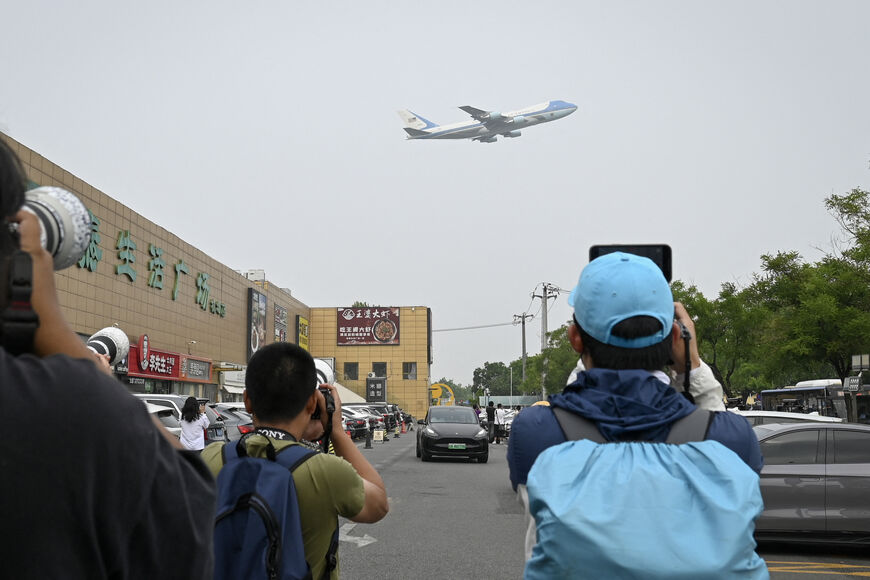
People gather to watch Air Force One, carrying US President Donald Trump, take off from Beijing Capital Airport in Beijing on May 15, 2026. (Photo by WANG Zhao / AFP via Getty Images)
At the heart of the issue for the United States is China’s role as Tehran’s primary economic lifeline. China remains the largest purchaser of Iranian oil, buying heavily discounted crude despite US sanctions.
The Trump administration has tried to pressure China on these matters. Treasury Secretary Scott Bessent last week publicly urged Beijing to use its leverage with Tehran to help reopen the Strait of Hormuz, while the United States has already sanctioned several Chinese refiners accused of purchasing sanctioned Iranian oil.
But Xi's commitment regarding military equipment may be less sweeping than Trump suggested to Fox on Thursday. China does not typically supply Iran with overt military hardware so much as dual-use technology that has both civilian and military applications. That includes, for example, a Chinese satellite system acquired by Iran in 2024, which Tehran later used to help target US military bases during the conflict, according to a Financial Times report.
Beijing gained some leverage on the sanctions issue. As he was boarding Air Force One on Friday, Trump told reporters that he and Xi talked about US sanctions on Chinese oil refiners, saying, "Well, we talked about that, and I’m going to make a decision over the next few days."
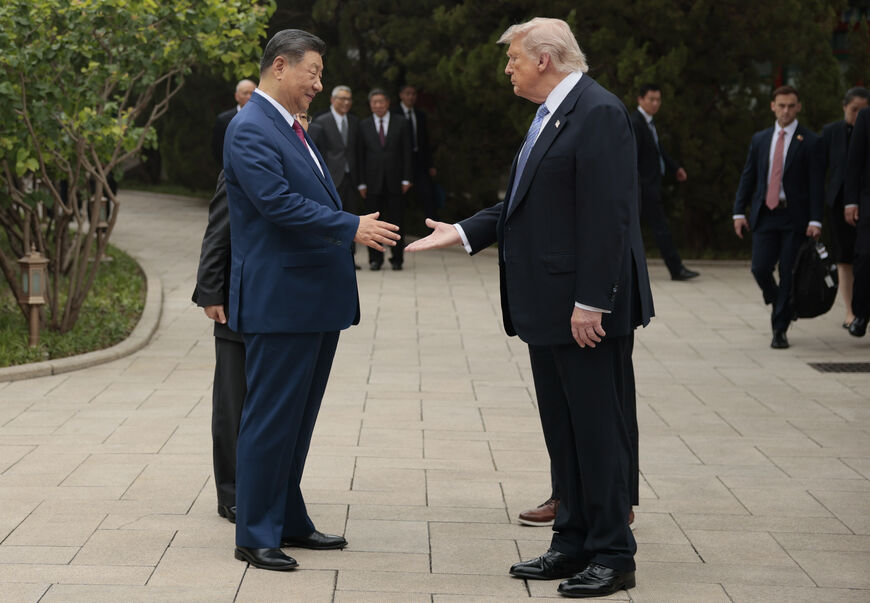
US President Donald Trump shakes hands with Chinese President Xi Jinping while leaving after a visit to the the Zhongnanhai Garden on May 15, 2026, in Beijing, China. (Photo by Evan Vucci-Pool/Getty Images)
What didn't happen
Beijing certainly has leverage over Tehran. But China is more invested in protecting its own economic and energy interests than in helping Trump achieve a sweeping diplomatic breakthrough. Trump, meanwhile, faces mounting domestic pressure to stabilize energy prices, avoid a prolonged regional conflict and demonstrate progress ahead of the election cycle. China, by contrast, can afford to be patient. Here's why:
China is indeed engaging with Iran on the strait, but not in the way that the US would like it to.
Iran’s Fars and Tasnim news agencies reported Thursday that some Chinese vessels had been cleared to pass through the Strait of Hormuz. Fars reported that the clearance came after diplomatic outreach by China’s foreign minister and ambassador to Tehran. Ship-tracking app MarineTraffic showed on Thursday that at least four China-linked vessels passed through the strait in the last 24 hours.
A US consumed by instability in the Middle East is a US with fewer diplomatic, military and political resources available for competition in the Indo-Pacific.
That does not mean Beijing wants an uncontrolled regional war or a prolonged disruption to Gulf energy flows and shipping, both of which would threaten China’s own economy. But China also has little incentive to help Washington quickly resolve a crisis that is absorbing its attention.
The conflict is creating defense openings for Beijing in the Gulf.
The Washington Post reported on Thursday, citing a US intelligence report, that China has sold weapons to Gulf allies of the US as they struggled to defend their military bases and oil infrastructure from Iranian missile and drone attacks.
Even if Beijing were willing to lean harder on Tehran, there is no guarantee it could actually secure Iranian compliance.
China's relationship with Iran's Islamic Revolutionary Guard Corps is largely transactional. Kuwait, for instance, said Tuesday that an IRGC unit attempted to infiltrate Bubiyan Island on May 1 — a site that hosts Mubarak Al Kabeer Port, a major infrastructure project being developed with Chinese involvement.
On top of this, as our correspondent in Tehran wrote, Iranian officials are wary that Chinese mediation could become a way to soft-pedal American demands.
Our take: China’s gains outweigh its losses in the Iran war in the short to medium term, but that balance is conditional. As a heavily export-dependent economy, China is particularly vulnerable to disruptions in global shipping lanes and sustained volatility in energy markets, making a prolonged conflict increasingly costly.
This one's on us.
The story doesn't end here.
Our correspondents are already on the next chapter. Read everything they file, from $2/week.
See Offers