King Abdullah visits China as region hedges against US unpredictability
With no end in sight to the war in Iran and an unchecked Israeli policy across the region, the kingdom is hedging against future uncertainty and a less predictable US policy.



You're reading an excerpt from Al-Monitor China-Middle East, where we analyze China's deepening engagement with the region. To get this newsletter in your inbox weekly, sign up here.
As the Middle East absorbs the ongoing fallout from the US-Israel-Iran war, China’s appeal is growing even among Washington’s closest regional partners.
Governments across the region are looking to Beijing for investment, technology and, increasingly, security cooperation. Egypt has expanded defense ties with China, while Gulf states are pursuing Chinese military and economic deals.
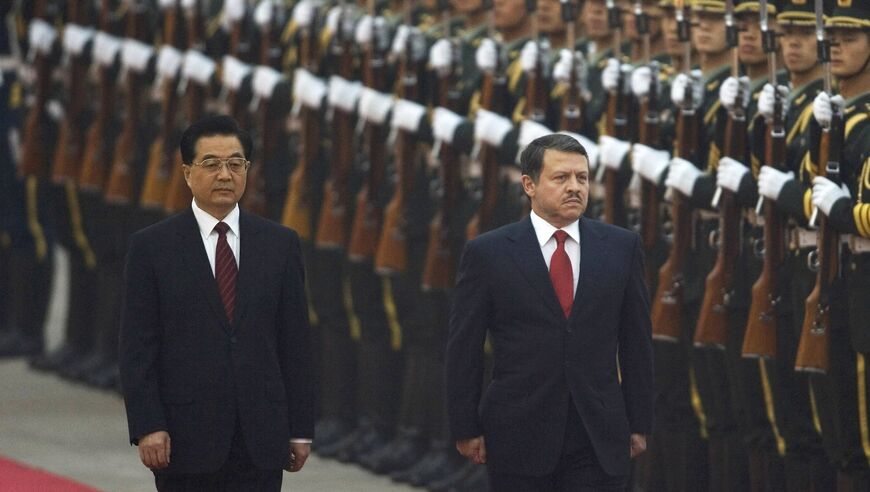
This week, Jordanian King Abdullah II joined the crowd, traveling to China for a weeklong stay, his first state visit there in more than a decade.
His trip does not necessarily signal a Jordanian pivot away from the United States. Rather, it reflects a broader regional recalibration. US partners are looking for more economic options and greater strategic room to maneuver in an increasingly uncertain regional environment.
A week across China
King Abdullah’s Aug. 18–24 visit kicked off in Shanghai and includes stops in Beijing and Shenzhen. It is his ninth trip to China since becoming king in 1999 and his first since 2015, when Jordan and China established a strategic partnership.
In Shanghai on Tuesday, the Jordanian monarch met executives from Chinese companies involved in pharmaceuticals, food, engineering, agriculture and aviation, according to a readout from the Royal Palace. He also visited AgiBot, a major Chinese robotics company, where he was briefed on applications ranging from manufacturing and logistics to hospitality and security.
King Abdullah arrived in Beijing on Thursday, according to Xinhua, where he is expected to meet President Xi Jinping, Premier Li Qiang and legislative leader Zhao Leji. Petra, Jordan’s official news agency, reported that the two sides expect to sign cooperation agreements and memorandums of understanding in several sectors. His visit to Shenzhen, China’s technology and manufacturing hub, underscores the commercial focus of the trip.
Jobs, energy and technology
Amman’s most immediate interest in China is economic. The US-Israel-Iran war has added to the economic pressure on Jordan, increasing the urgency of attracting investment and diversifying the economy. Tourism, which accounts for 10%–15% of GDP, has been hit by the regional instability, while higher energy costs and disruptions to trade and air travel have stressed an economy heavily dependent on imports.
In an interview with Chinese state outlet Xinhua on Monday, King Abdullah seemed keen to emphasize opportunities for economic cooperation, saying that Jordan is “well positioned to serve as a regional manufacturing and export hub. Chinese manufacturing investments could leverage this position, benefiting from our natural resources, skilled workforce, stable business environment, strategic location and extensive network of trade agreements.”
Jordanian-Chinese trade reached nearly $6.7 billion in 2025, according to the Jordan Times, but the relationship is heavily tilted in Beijing’s favor. Chinese exports to Jordan totaled about $6.29 billion, compared with just $430 million in Jordanian exports to China. That imbalance helps explain Amman’s focus on attracting investment, technology and productive capacity rather than simply expanding trade.
China could play a larger role in Jordan’s Economic Modernisation Vision, the kingdom’s long-term effort to accelerate growth and absorb at least 1 million new young workers into the labor market by 2033. Energy is an area where that cooperation is already taking shape.
In September 2025, Jordan signed an agreement with China’s UEG Green Hydrogen Development Holding Limited to study a proposed $1.155 billion green hydrogen project. The aim is to produce about 200,000 tons of green ammonia annually for export.
For Jordan, however, the attraction goes beyond potential Chinese investment. Manufacturing expertise, renewable energy technology and access to Chinese supply chains could also help Amman build domestic industrial capacity and create private sector jobs.
"Timing says everything"
Taylor Luck, a longtime Amman-based journalist and senior Middle East correspondent for The Christian Science Monitor, said the significance of the king’s visit lies in its timing.
“King Abdullah traveling to China is not newsworthy on its own, but the timing says everything,” Luck told Al-Monitor.
The visit, he added, reflects a growing recognition in Amman that relying too heavily on a single economic and security partner carries risks.
“While it is not a rebuke of Washington,” Luck said, “a weeklong visit by King Abdullah to China at the time of a deep regional crisis signals a recognition in Jordan that its over-reliance on America is not sustainable in the long term, and increasingly, not even in the short term.”
Luck estimates that Chinese investment in Jordan stands at around $3.56 billion. Although a significant sum, it is well below Beijing’s footprint in larger regional markets, such as Egypt and Iraq.
The expert also sees Jordan making the broader strategic calculation of positioning itself “to tie the kingdom’s economic future to supply chains and Hormuz-alternative corridors that may emerge from the current war.” Renewable energy offers one potential avenue.
Jordan has significant silica deposits, a key raw material for the silicon used in solar panels. China dominates much of the global solar manufacturing supply chain, and its expertise could potentially help the kingdom carve out a larger role in that industry.
Washington remains indispensable
Jordan’s outreach to China has clear limits. The United States authorized a $2.1 billion package of economic, military and budgetary support to the kingdom in 2026, and its security relationship with Washington remains central to stability and national defense.
Luck, however, argues that the rise of America First sentiment across the US political spectrum has sharpened Amman’s concern that such levels of assistance may not continue indefinitely.
“Jordan will not be able to count on such assistance in the years to come,” he said. “The king’s tour may not immediately yield any direct Chinese investments or joint Jordanian-Chinese projects, but the scope and geographic reach of the visit alone may set the tone for closer Jordanian-Chinese ties in a very different postwar Middle East.”
Joyce and Rosaleen's take: Jordan is not choosing Beijing over Washington; rather, Amman is pursuing a middle path — preserving the US relationship underpinning its security while expanding ties with China for greater political and economic stability. With no end in sight to the war in Iran and an unchecked Israeli policy across the region, the kingdom is hedging against future uncertainty and a less predictable White House.
This one's on us.
The story doesn't end here.
Our correspondents are already on the next chapter. Read everything they file, from $2/week.
See Offers