Why renewed Egypt-Ethiopia tensions are a problem for China
For Beijing, the renewed Egypt-Ethiopia standoff is a zero-sum bind that threatens vital strategic interests on both sides of the Nile.


You're reading an excerpt from Al-Monitor China-Middle East, where we analyze China's deepening engagement with the region. To get this newsletter in your inbox weekly, sign up here.
The renewed Egypt-Ethiopia escalation is a lose-lose proposition for China that threatens vital interests in both countries. As Cairo and Addis Ababa trade diplomatic expulsions, revive disputes over the Nile and over regional security and access to the Red Sea, Beijing faces mounting pressure to protect ties with two of its most important African partners.
From infrastructure and trade to security and diplomacy, China has deepened its web of interests in both Egypt and Ethiopia, emerging as the economic partner of choice in the Horn of Africa and within the wider Belt and Road network. While doing so, Beijing has tried to maintain a careful balance even as conflicts and bitter rivalries gripped that region.
The new round of escalation reached its peak last week as Ethiopia expelled an Egyptian diplomat, prompting Cairo to respond in kind by declaring an Ethiopian Embassy counselor persona non grata. The reciprocal moves came amid a broader regional escalation: Addis Ababa accused Egypt, Eritrea and Sudan last month of supporting a Tigray People’s Liberation Front-led opposition alliance, allegations all three countries deny.
Egypt then hosted a four-way summit with Eritrea, Sudan and Somalia on Oct. 4. The leaders stressed sovereignty and territorial integrity, said Red Sea security should remain primarily the responsibility of littoral states and rejected unilateral measures affecting the established water rights of downstream Nile countries.
The dispute has historically centered on two issues: access to the Red Sea and its management of the Grand Ethiopian Renaissance Dam (GERD). Cairo fears that unilateral operation of the dam, particularly during drought, could threaten water supplies in a country heavily dependent on the Nile. Ethiopia considers the project essential to electricity generation and economic development.
China’s critical ties with both
As Cairo and Addis Ababa trade accusations, Beijing is increasingly caught between a rock and a hard place. Egypt has only expanded ties with China in the last decade and Egyptian President Abdel Fattah al-Sisi has made eight official visits to China since taking office in 2014.
The economic relationship is substantial as Chinese companies expand their industrial presence in the Suez Canal Economic Zone while security and tech ties have only grown in the last decade. Egyptian officials said in September that 3,366 Chinese companies were operating in the country across sectors including textiles, solar energy, chemicals, automotive manufacturing and logistics. Bilateral trade reached $11.3 billion in the first half of 2026, up 21.5% from a year earlier. During President Xi Jinping’s September visit to Cairo, the two countries pledged to deepen cooperation in infrastructure, energy, manufacturing, artificial intelligence, renewable energy, electric vehicles and the digital economy.
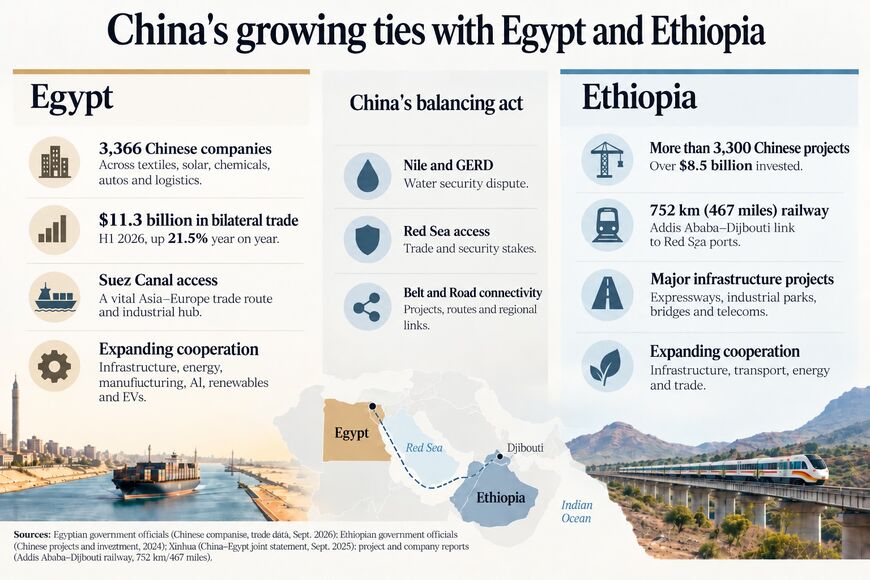
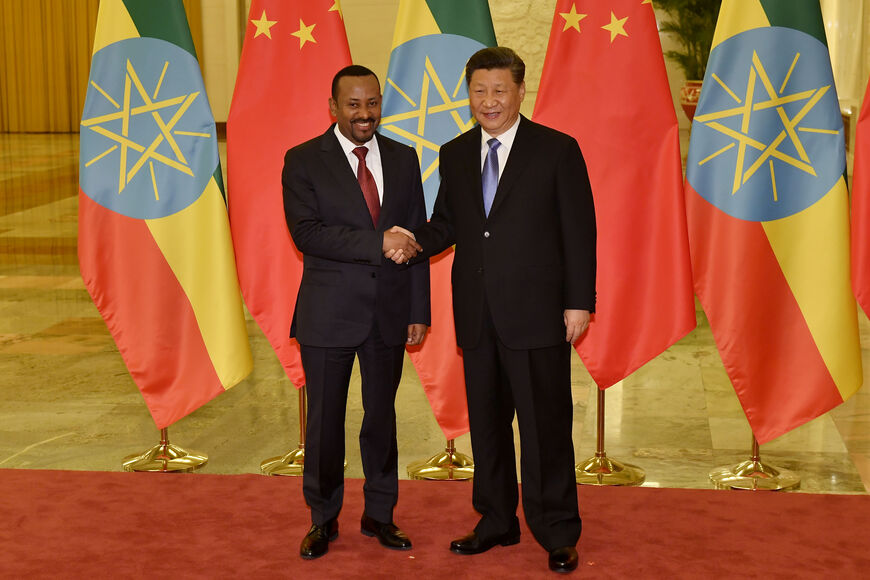
Ethiopia is just as strategically important for China, and its recently reelected President Abiy Ahmed has visited Beijing four times since 2018. The two countries flaunted their “all-weather strategic partnership” in 2023 spanning infrastructure, transport, energy and trade.
Between 2010 and 2018, Chinese firms built the 752-kilometer Addis Ababa-Djibouti railway, the Addis Ababa-Adama Expressway and major industrial parks, bridges and telecommunications projects. Chinese state-owned enterprises dominate the shortlist for construction contracts on Ethiopia's new $12.5 billion Bishoftu International Airport project, according to Reuters.
A tilt toward Cairo
China has traditionally avoided openly taking sides in the GERD dispute. But during Xi’s September visit to Egypt, Beijing moved closer to Cairo’s language.
In their joint statement, China recognized the Nile as Egypt’s “primary lifeline” and affirmed Egypt’s right to safeguard its water and food security. Both sides also called on Nile Basin states to respect international law and the principle of avoiding harm to other countries.
The statement did not name Ethiopia or directly oppose the GERD. Still, it supported principles Egypt has long invoked in calling for binding rules governing the dam’s operation.
China and Egypt also said Red Sea governance and security should primarily remain in the hands of littoral states — another sensitive issue for landlocked Ethiopia, which has increasingly pushed for reliable access to the sea.
What’s at stake
For China, the risk goes beyond diplomacy.
Renewed fighting in northern Ethiopia could further destabilize Tigray and surrounding regions and potentially draw in neighboring states. China already experienced the commercial consequences of the previous Tigray conflict, when it evacuated hundreds of Chinese nationals in 2020 working on projects in the region.
More broadly, China’s Belt and Road strategy in the Horn depends on regional connectivity. Ethiopian industrial centers are linked to Djibouti’s ports through the Chinese-built Addis Ababa-Djibouti railway, connecting them to Red Sea shipping lanes and the Suez Canal.
A wider conflict could disrupt those supply chains, increase security and transport costs and make new investment riskier.
Cameron Hudson, a senior fellow in the Africa Program at the Center for Strategic and International Studies (CSIS), the current situation limits Beijing’s options.
“China offers predictability in its engagement, but it looks for stability in return,” Hudson explained in an interview. “Feuds among its partners create a challenging operating environment.”
That leaves Beijing with a difficult balancing act: support regional stability, push for mediation and strengthen ties with Cairo without alienating Ethiopia.
But mediation isn’t China’s strong suit in the Horn, Hudson argued.
“China’s diplomacy is not typically set up to mediate. Its strength is in managing a bilateral relationship, but has not traditionally excelled in managing competing interest across the region,” he said.
So what is realistic for China in mitigating the fallout? Hudson expects Beijing to take a wait-and-see approach.
“China might hit the pause button for the moment and re-engage when things have settled down. They typically let Washington do the heavy lifting,” he said.
The problem, however, is that Washington is not actively mediating either.
This one's on us.
The story doesn't end here.
Our correspondents are already on the next chapter. Read everything they file, from $2/week.
See Offers