Pope Leo gets rock star's reception in Lebanon, drawing cheers, celebrations
Pope Leo began his second day in crisis-hit Lebanon with visits to notable Christian shrines in the country and an interfaith meeting in the capital, Beirut.


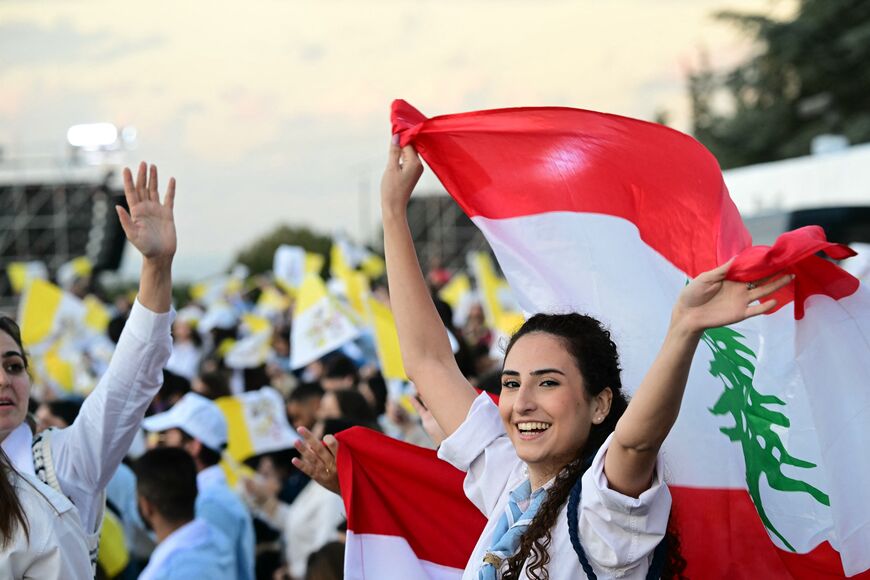
BEIRUT — Pope Leo XIV received a rock star welcome in Lebanon, with thousands of cheering crowds braving the rain for his arrival. As he began his second day in the crisis-hit country, long lines of people packed the streets and squares to greet the pontiff, turning out in force for the historic visit. Their enthusiastic reception underscored his message of hope, peace, and reconciliation as Lebanon faces the renewed threat of conflict with Israel just a year after a fragile ceasefire ended a devastating war.
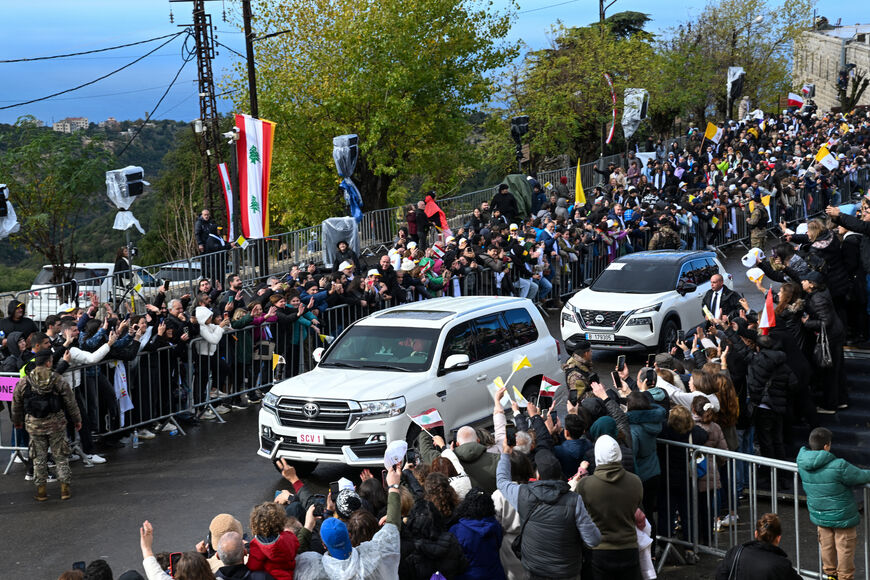
Thousands packed Beirut’s streets, waving both Lebanese and Vatican flags outside churches and monasteries to welcome Pope Leo XIV. From mountain villages to bustling city squares and the suburbs of Beirut, crowds turned out in force, undeterred by rain, to welcome Pope Leo as a messenger of hope and peace.
Saint Charbel Shrine
His first stop Monday morning was the Monastery of Saint Maroun in the town of Annaya, about 52 kilometers (32 miles) north of Beirut, where he held a silent prayer at the tomb of Saint Charbel, Lebanon’s patron saint.
Superior-General of the Lebanese Maronite Order Father Hadi Mahfouz welcomed the pope and presented him with a copy of the first Psalter (a book containing psalms), printed in 1610 by the Monastery of Saint Antonios Qozhaya in the historic Qadisha Valley. The book features text in both Syriac and Garshuni (Arabic written in Syriac script). Father Mahfouz also offered the pope a handheld lamp of Saint Charbel containing his relics and a honeycomb candle made by the monks bearing the papal emblem.
In turn, Pope Leo presented the monastery with a handcrafted silver-bronze votive lamp he brought from the Vatican.
“In offering this lamp, I entrust Lebanon and its people to the protection of Saint Charbel — that they may always walk in the light of Christ. Let us thank God for the gift of Saint Charbel! And thank you for preserving his memory. Walk in the light of the Lord!” the pope said.
Each year, thousands of pilgrims flock to the Saint Charbel Shrine, a Catholic Maronite monk and hermit who is believed to have performed over 33,000 healing miracles, according to the records of the monastery of Saint Maroun.
“We ask for peace. We implore it especially for Lebanon and for the whole Levant. But we know — and the saints remind us — that there is no peace without the conversion of hearts,” the pope said in his speech, which he delivered in French.
Our Lady of Lebanon
After greeting and blessing the crowds gathered in the rain at the monastery, the 68-year-old pontiff made his way to the Basilica of Our Lady of Lebanon in Harissa, 26 kilometers (16 miles) north of Beirut.
"The Lord be with you.. And with your spirit!" Listen to the enthusiasm from the congregation as Pope Leo opens with prayer at the Shrine of Our Lady of Lebanon. So far, the Lebanese welcome for Pope Leo has been incredible. pic.twitter.com/l3C4f9Ih80
— Colm Flynn (@colmflynnire) December 1, 2025
There, he met with bishops, priests, consecrated men and women, and pastoral workers, while hundreds of others gathered in the area. The pope listened to the testimonies of several people, including a nun from the Congregation of the Sacred Hearts of Jesus and Mary in Baalbek in eastern Lebanon, who recounted how she stayed there despite the war last year, opening the church to both Muslims and Christians fleeing the Israeli bombardment.
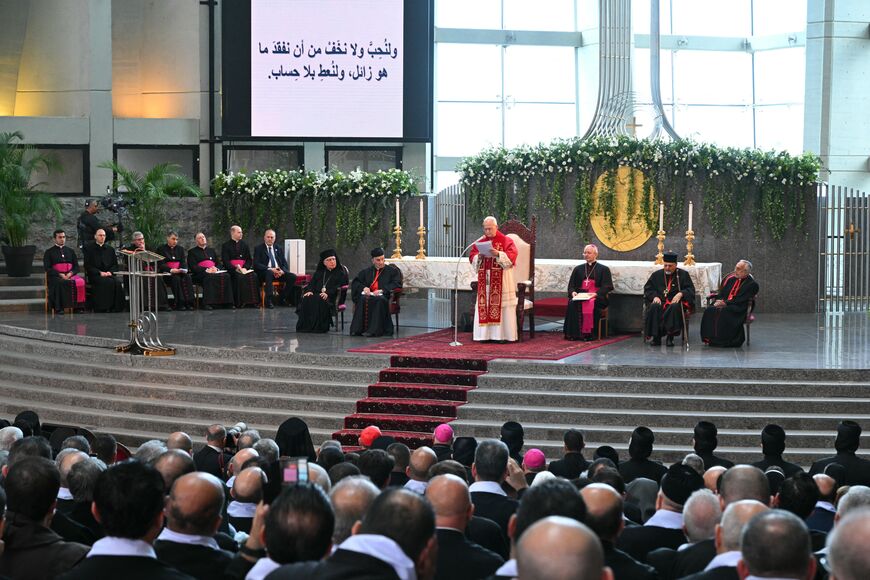
“It is in being with Mary at the foot of Jesus’ cross that our prayer — that invisible bridge which unites hearts — gives us the strength to continue to hope and work, even when surrounded by the sound of weapons and when the very necessities of daily life become a challenge,” the pope said, responding to the testimonies.
He addressed the crowd in a speech, also delivered in French, where he reiterated his visit’s motto: “Blessed are the peacemakers.”
Before heading off to the papal embassy in the same town for private meetings, the pope presented a Golden Rose to the shrine, saying it symbolizes the “fragrance of Christ” that is accessible to all. He also received several gifts from representatives of Our Lady of Lebanon Shrine, including a bronze statue of a bridge between Lebanon and the Holy See.
Interfaith meeting in Beirut, show of coexistence
The popemobile, accompanied by a large convoy and helicopters of the Lebanese army, later took off toward Martyrs' Square in Beirut, as hundreds of people lined up along the road leading to the capital.
Set against the backdrop of the large Mohammad al-Amin Mosque and the nearby Saint George Maronite Cathedral, Martyrs’ Square hosted a highly significant ecumenical and interfaith dialogue meeting between Pope Leo and members of Lebanon’s various sects and faiths, reflecting the country’s religious pluralism.
وصول البابا لاون الرابع عشر إلى ساحة الشهداء#LBCI #LBCILebanon #LBCILebanonNews #LBCIVideos #LBCINews #BreakingNews #Lebanon #لبنان pic.twitter.com/biCG9HFeZM
— LBCI Lebanon News (@LBCI_NEWS) December 1, 2025
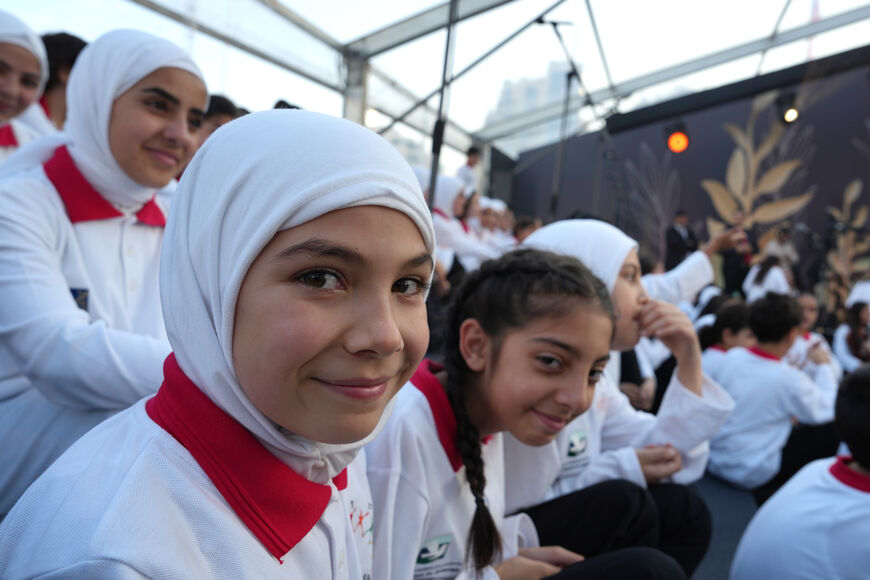
The leaders of eight Christian and Muslim sects delivered separate speeches during the gathering, praising coexistence in the country and reaffirming respect for all religions.
A sung reading of the Gospel according to the Byzantine rite and the recitation of verses from the Quran were featured during the event, with singers from the choirs of Beirut Chants El Sistema, the Islamic Orphanage and the Imam Sadr Foundation also performing there.
Message of peace, unity
Pope Leo landed at the Rafic Hariri International Airport in Beirut Sunday afternoon, where he was welcomed by President Joseph Aoun, Prime Minister Nawaf Salam, parliament speaker Nabih Berri and Maronite Patriarch Bechara al Rai, among other senior figures.
القوات الجوية في الجيش تستقبل قداسة البابا لاوون الرابع عشر وترحب به#الجيش_اللبناني #LebaneseArmy pic.twitter.com/wzXPefdy8X
— الجيش اللبناني (@LebarmyOfficial) December 1, 2025
Braving heavy rain, thousands of people lined the streets from the airport to the Baabda Presidential Palace, waving Lebanese and Vatican flags to welcome the pope.
Upon his arrival, he was greeted by large crowds, traditional Lebanese dabke folk dancers and horsemen, all standing in the rain. He was also treated to a light show featuring his image alongside the cedar tree — the national symbol representing resilience and hope — surrounded by doves of peace and the Vatican’s emblem.
After meeting with Aoun and other officials, Pope Leo delivered a speech in which he praised the resilience of the Lebanese people despite the wars and economic hardships.
“You have suffered greatly from the consequences of an economy that kills, from global instability that has devastating repercussions also in the Levant, and from the radicalization of identities and conflicts,” the pontiff said. “You are a people who do not give up. You rise in the face of difficulties and know how to be reborn.”
He urged Lebanon’s political leaders to put aside their partisan differences to achieve reconciliation and peace.
“Peace is much more than a precarious balance between those who live separately under the same roof. Peace is knowing how to live together, in communion, as reconciled people. A reconciliation that, in addition to enabling us to live together, will teach us to work together, side by side, for a shared future. And then, peace becomes that abundance that surprises us when our horizon expands beyond every fence and barrier,” he said.
Lebanon still has one of the largest Christian populations in the Middle East, despite decades of decline caused by recurring conflicts and sectarian violence. Today, Christians make up around a third of the country’s roughly 6 million people. Still, the presidency is reserved for a Maronite Christian under Lebanon’s sectarian power-sharing system, making it the only Arab country with a Christian head of state.
On Tuesday, Pope Leo will visit De La Croix Hospital, a Catholic-run psychiatric facility in Jal el-Dib, about 10 kilometers (6 miles) north of Beirut, and the site of the 2020 Beirut port explosion, where he will hold a silent prayer for the victims of the blast that killed more than 200 people and injured thousands.
The Holy Father will conclude his visit with a highly anticipated public mass to be held on the Beirut waterfront, with hundreds of thousands expected to attend.
Hezbollah’s position
Pope Leo’s visit to Lebanon, despite Israeli escalation and security tensions, reflects his commitment to supporting the Lebanese people and promoting a message of peace and coexistence.
Israel has in recent weeks intensified its airstrikes in southern and eastern Lebanon, despite a US-brokered ceasefire reached last year. A few days before the pope’s visit to Beirut, an Israeli strike killed Hezbollah’s second-in-command, Ali Tabatabai, in Dahiyeh on Nov. 23 — the first assassination of a top Hezbollah operative since the November 2024 ceasefire. The attack marked a major escalation, further deepening concerns of a return of the war that had pitted the Iran-backed group against Israel.
On Saturday, Hezbollah addressed a message to Pope Leo ahead of his arrival in Beirut, urging him to condemn Israel’s “injustice and aggression” against Lebanon.
“We in Hezbollah take advantage of the occasion of your auspicious visit to our country Lebanon to reaffirm from our side our commitment to coexistence,” read Hezbollah’s message, which circulated on social media.
“We rely on your holiness’ stance in rejecting the injustice and aggression our nation of Lebanon is subjected to at the hands of the Zionist invaders and their supporters,” the message read.
Hundreds of members of the Imam al-Mahdi Scouts affiliated with Hezbollah joined the crowds on Sunday and stood along the airport road leading to the presidential palace to welcome the Holy Father.
Pope Leo will not be visiting southern Lebanon.
This one's on us.
The story doesn't end here.
Our correspondents are already on the next chapter. Read everything they file, from $2/week.
See Offers