Turkish artist Ipek Duben’s early years return to the wall
In solo exhibition “'70-,” Istanbul-born artist Ipek Duben opens the files she once kept to herself, tracing the foundations of a five-decade career shaped by identity, power, gender and belonging.


The most arresting moment in Ipek Duben’s new exhibition of her early years comes at its very end. The artist seems aware of it, too, as she stands before the final wall — her Mireille Mathieu-like bob streaked with blue and a strand of deep-blue beads at her neck — becoming almost another element in the gallery’s color-rich palette. Behind her, early sketches come together like clues: a study of her tall, wiry husband, Alan Duben; a view from their Istanbul apartment before the move to the United States; and works made from discarded objects. The room feels less like a conclusion and more like a door that opens onto decades of politically charged art.
More than 50 years after she left a political science doctorate unfinished, Duben is revisiting that decisive break in “'70-,” a compact exhibition at Istanbul’s Galerist. Curated by Farah Aksoy and Amira Arzik, the show centers on early works that trace the emergence of the layered, spatial sensibility that would later define her practice in the 1970s and '80s.
“Even the artist herself did not think of them as formal works, which is why they stayed in files for decades before being brought together now,” Arzik told Al-Monitor during the tour. “We were honored to display them after years because, put together, they show the audience the different stages of her career.”
Born in Istanbul in 1941, Duben studied philosophy at Agnes Scott College, then completed an MA in political science at the University of Chicago in 1965, continuing toward a doctorate there until 1971.
“I sat for 28 hours of written doctoral exams,” she told Al-Monitor. “At some point, you say to yourself, 'I don’t want to live my life like this.'” So she made what she now calls a leap of faith: She abandoned the PhD and turned to art, driven, as she puts it, by “a need to express myself, to enter my own world.”
After leaving political science, she enrolled at the New York Studio School and attended it between 1972 and 1976, training with artists whose works were shaped by abstract expressionism. That education, she says, was about “gaining space, animating emptiness, creating energy” — concerns that would underpin her practice across painting, video, artist’s books and installations.
The works in “'70-,” hung in a loose chronological rhythm, read as a visual diary of a young artist testing what a line, a block of black or a shift in density can do. The first room operates like an overture: single-color works and pared-down compositions that insist on the page being a site of tension.
“These are my energetic, optimistic years,” Duben told Al-Monitor. The drawings and paintings are full of black, but without, as she insists, any melodrama. “They are very energetic, positive works.” The focus in those years was on her experimentation of the relationship between positive and negative space, the effort to make a blank sheet come alive.
As the exhibition progresses, the political scientist — one who is deeply engaged with social struggles, gender identity and migration — merges with the artist. Sketches of female forms, which began in the mid-1970s and continued through the 1980s, lead us to one of the exhibition’s focal works, "Suspended" — two ink-on-paper compositions that suspend a solitary figure in midair, represented by trembling lines that underline her vulnerability. This is a theme she used in her work “LoveBook“ (1998-2001), in which she presented 120 cases of domestic violence in Turkey and the United States with clippings.
Story of the other
If “'70-” is about foundations, it's Duben's additions to them that make her important and relevant to a wider international audience. From the early 1980s on, she turned toward explicitly political themes. Her “Sherife” series (1980-1982), composed of 11 oil paintings and one charcoal drawing, presents vivid, floating dresses that stand in for Sherife, a house cleaner from an Anatolian village who was abandoned by her husband and pushed to Istanbul so her son could study. Duben bought the dresses at a street market, stuffed them with newspaper to emphasize their emptiness and painted them as bodiless forms whose conservative cuts and colors encode class and gender while revealing almost nothing about the woman who wore them — a pointed reminder of the invisibility of domestic labor and the women who sustain it.
Two decades later, she scaled this critique up to the level of national identity. “What is a Turk?”— 30 postcards gathered into six concertina packs — assembles Western textual and visual references, from travelogues to newspaper clippings, depicting the “Turk” as an "other" and exposing a long history of stereotyping and exoticization.
Her multichannel video installation, “They” (2015), was first shown at Salt Galata and later in Brighton. "They" is a multiscreen video installation in which 24 people — including Kurds, Alevis, Armenians, Jews, LGBT individuals, covered Muslim women and women violated by their husbands — speak about how they are seen as “others” and how they see one another. Appearing and disappearing across shifting screens and sound, their overlapping stories create a shared space of listening that momentarily places everyone on equal ground.
In conversation at the “'70-” exhibition, Duben links this long-running engagement with identity and power to a broader, darker view of the present. “I am happy that I am not younger,” she told Al-Monitor, citing the “dire straits of the world”: the rise of fascist leaders and the corrosive effects of global capitalism, ecological disaster and a world in which technology elites and their millions of followers seem to inhabit “another world” — a future she half-jokingly calls “after the human race.”
“If you have seen my works at the Istanbul Biennial,” she said, “they tell how capitalism and consumerism wear people down, eats them.”
Her contributions, “Children of Paradise” II, III, IV and “Peggy’s Paradise,” are among the most provocative in the edition, curated by Lebanese activist Christine Tohme. They were widely regarded as some of the strongest works in the biennial, distilling her mischievous yet razor-sharp critique of consumption culture. Arranged like a cross between a shop window and a shrine, the installation exposes the seductions of consumerism while underscoring her long-standing concern with the violence and waste embedded in contemporary material appetites.
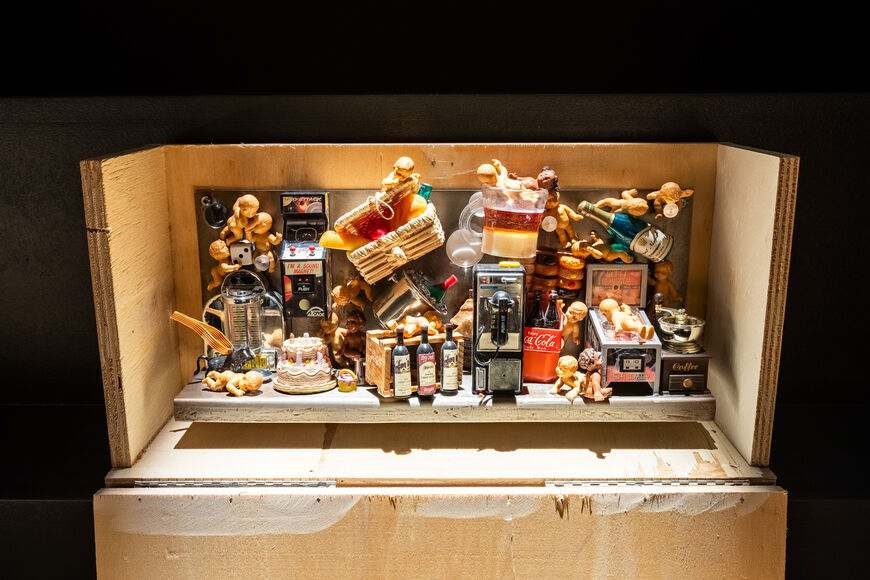
Ipek Duben's work "Children of Paradise" displayed at the 18th Istanbul Biennial. (Credit: Nazlan Ertan)
Though some international viewers know her from biennials, museum retrospectives and British Museum catalogues, “'70-” offers something rare: a glimpse of the journey behind the politics. Between those searching lines and blocks of black, you can already sense the artist who would spend the next 40 years asking who is seen, who is silenced and how art can make those structures visible.
“’70-" runs at Galerist in Istanbul until Jan. 3, 2026.
This one's on us.
The story doesn't end here.
Our correspondents are already on the next chapter. Read everything they file, from $2/week.
See Offers