UAE's Sky News Arabia split from Sky raises issue of media, power in Gulf
UK-based Sky News recently announced that it would relinquish its stake in the 24-hour Arabic-language channel launched with Emirati partner International Media Investments.


Sky News Arabia coverage of the civil war in Sudan may have contributed to the decision by Sky News to relinquish its stake in the Abu Dhabi-based broadcaster, but experts say that regardless, it was unlikely the sole or decisive factor.
Debate over the reason for the move emerged after the UK newspaper The Guardian reported that editorial concerns — particularly over Sky News Arabia reporting on the Sudan conflict — played a role in Sky's decision. According to the report, some Sky executives had grown uncomfortable with coverage that critics claimed downplayed atrocities committed by the paramilitary Rapid Support Forces (RSF).
UK-based Sky News announced on May 31 that it would relinquish its stake in Sky News Arabia, the 24-hour Arabic-language news channel it launched with Emirati partner International Media Investments (IMI) in 2012. Under the agreement, IMI — controlled by Sheikh Mansour bin Zayed Al Nahyan, vice president of the United Arab Emirates — will assume full ownership while retaining the Sky News Arabia brand under a multiyear licensing deal.
Public scrutiny
The UAE has faced repeated accusations from United Nations sanctions monitors and rights groups of providing military support to the RSF, which has been fighting the Sudanese Armed Forces (SAF) since 2023. Abu Dhabi strongly denies the allegations.
It was against this backdrop that Sky News Arabia came to face criticism over its coverage of the conflict and that The Guardian reported on May 31 that concerns over the channel's editorial line on Sudan were among the factors behind Sky's decision to exit the venture.
In November, the channel came under scrutiny from Sudanese authorities. That month, Sudan's government, led by General Abdel Fattah al-Burhan, banned Sky News Arabia from operating in the country after it aired a report from El Fasher, in North Darfur, portraying the humanitarian and security situation as having stabilized following the city's fall to the RSF in late October. Critics said the report failed to reflect the realities on the ground, contradicting the dire conditions documented by humanitarian groups.
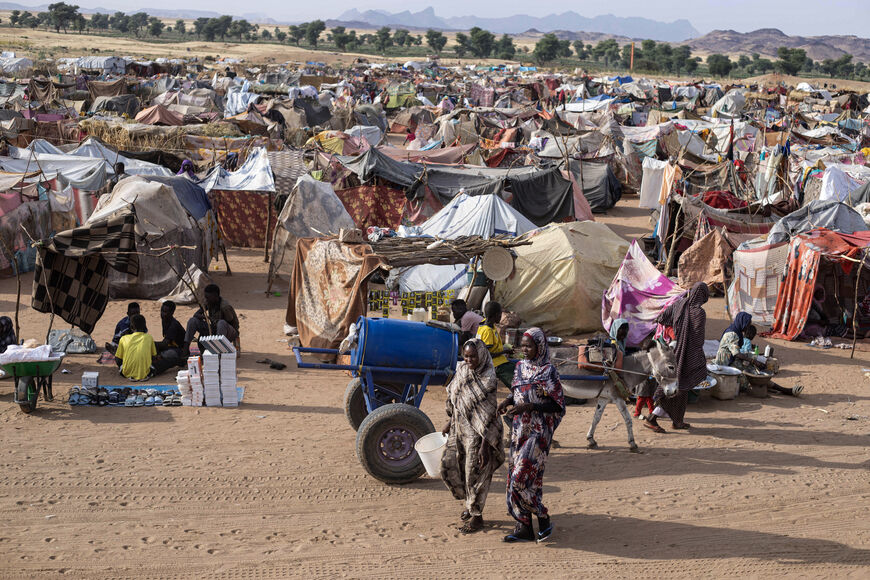
Amid a two-year siege, El Fasher, the last SAF stronghold in all of Darfur, had fallen to the RSF, after which more than 6,000 people were killed in a massacre, according to estimates by rights groups. Tens of thousands were forced to flee the city.
Questions were further raised in November after the RSF, having taken El Fasher, granted Sky News Arabia presenter Tsabih Mubarak access to the city at a time when most aid workers and journalists were unable to enter. Mubarak is married to Ibrahim al-Mirghani, a Sudanese politician who has publicly backed the RSF during the conflict, raising questions about the impartiality of her reporting.
UAE-owned Sky News Arabia presenter Tsabih Mubarak (left) poses with an RSF officer (right), accused of inciting sexual violence towards Sudanese women, in El-Fasher, Sudan, on 9 November 2025 (Screengrab/TikTok): https://t.co/Cr8shbX9j0 pic.twitter.com/47rLxKYiry
— Роза (@CanvasMedu10139) November 12, 2025
The Burhan government had also previously suspended Sky News Arabia in April 2024, along with the Saudi-owned Al Arabiya and Al Hadath, prohibiting operations in the country for what it described as a “lack of professionalism and transparency.”
“There's no question that the UAE sees the Sudan conflict through the lens of its own national interest, that the way that it reports on the ground from Sudan is very different from what the global consensus has been,” Kristin Smith Diwan, a senior resident scholar at the Arab Gulf States Institute, told Al-Monitor. “It’s reasonable to think that may have put them in conflict with the Sky News executives, as has been reported."
Other motivations
Some observers caution against overstating the Sudan war's role in the split.
“The Sudan issue is always way down the list of priorities in commercial, political or diplomatic engagements with the Emirates,” Alex de Waal, executive director of the World Peace Foundation, told Al-Monitor. “I think it ought to be a factor, but I’d be surprised if it is the decisive one.”
He noted that all other attempts had failed to turn outrage over Sudan into a broader political story that would embarrass any government or company dealing with the UAE.
A source familiar with the deal told Al-Monitor that the Sky News exit merely represents an evolution in a long-standing partnership and the next phase of the relationship, not a response to a single issue. According to the source, the move was driven by commercial considerations rather than editorial concerns.
Nadim Koteich, former general manager of Sky News Arabia, also hit back at The Guardian article, calling it “lazy journalism” that misrepresents the reasons behind the decision.
“If it were about editorial integrity, why was a licensing agreement signed allowing ‘Sky News Arabia’ to retain the brand for several years, as the report itself states?” Koteich wrote on X, adding that the decision was “simply not an editorial punishment.”
Koteich did not respond to Al-Monitor’s request for further comment about the decision.
Merissa Khurma, a Gulf expert and chief executive of AMENA Strategies, a Washington-based policy consultant, said that GCC governments understand that framing their own narrative matters in today's fast-paced social media landscape.
“The [deal's] timing is critical because the regional geopolitical and geoeconomic landscape is marred with uncertainty, calling for new thinking and reassessments of their vision and plans for growth, security and stability,” Khurma told Al-Monitor. “It is a matter of national interest for them to take the reins again and have more control.”
Gulf media consolidation
For Diwan, the licensing agreement alone raises questions about the argument that Sky’s primary concern was protecting its reputation for impartial journalism.
“I imagine keeping the Sky News branding is important to the UAE, and now they have editorial control over their product as well,” she said.
Instead, Diwan views the takeover as part of a broader regional trend toward media consolidation under state and ruling-family control.
“It's part of the global trend towards nationalism and demanding media represent national interests. That's true for the UAE, as it is for many countries,” she remarked.
Diwan noted that the Gulf’s three largest economies — Qatar, Saudi Arabia and the UAE — have all consolidated, or are consolidating, major media assets under state-linked ownership.
This one's on us.
The story doesn't end here.
Our correspondents are already on the next chapter. Read everything they file, from $2/week.
See Offers